Derivatives from graphs Use the figure to find the following derivatives. <IMAGE> d/dx (xg(x)) | x=2
Verified step by step guidance
1
Step 1: Recognize that you need to find the derivative of the product of two functions, x and g(x), at x = 2. This requires using the product rule for differentiation.
Step 2: Recall the product rule formula: if you have two functions u(x) and v(x), then the derivative of their product is given by (u(x)v(x))' = u'(x)v(x) + u(x)v'(x).
Step 3: Identify u(x) = x and v(x) = g(x). Compute the derivatives: u'(x) = 1 and v'(x) = g'(x).
Step 4: Apply the product rule: (xg(x))' = 1 * g(x) + x * g'(x).
Step 5: Evaluate the expression at x = 2: substitute x = 2 into the expression 1 * g(x) + x * g'(x) to find the derivative at that point. Use the graph to find the values of g(2) and g'(2).
Verified video answer for a similar problem:
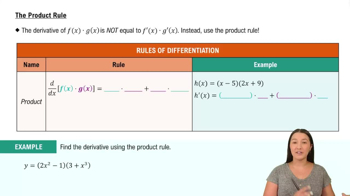
This video solution was recommended by our tutors as helpful for the problem above
Video duration:
3m
Play a video:
Was this helpful?
Key Concepts
Here are the essential concepts you must grasp in order to answer the question correctly.
Product Rule
The Product Rule is a fundamental differentiation technique used when finding the derivative of the product of two functions. It states that if you have two functions, u(x) and v(x), the derivative of their product is given by d/dx [u(x)v(x)] = u'(x)v(x) + u(x)v'(x). This rule is essential for solving problems involving products of functions, such as xg(x) in the given question.
Evaluating derivatives involves substituting a specific value into the derivative function to find the slope of the tangent line at that point. In this case, after applying the Product Rule to find d/dx (xg(x)), you will substitute x = 2 into the resulting expression. This step is crucial for determining the instantaneous rate of change of the function at that specific point.
Function notation is a way to represent functions and their derivatives clearly. In the expression g(x), g represents a function of x, and its derivative is denoted as g'(x). Understanding function notation is vital for interpreting the problem correctly, as it allows you to identify the functions involved and apply the appropriate differentiation rules effectively.