
Textbook Question
Vertical tangent lines
a. Determine the points where the curve x+y³−y=1 has a vertical tangent line (see Exercise 60).
367
views

 Verified step by step guidance
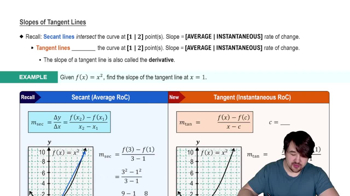
 05:13
05:13
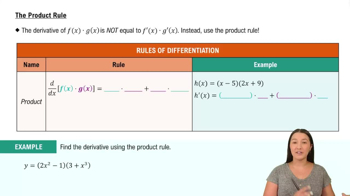 05:18
05:18 05:02
05:02Vertical tangent lines
a. Determine the points where the curve x+y³−y=1 has a vertical tangent line (see Exercise 60).
Find an equation of the line tangent to the following curves at the given value of x.
y = 4 sin x cos x; x = π/3
Highway travel A state patrol station is located on a straight north-south freeway. A patrol car leaves the station at 9:00 A.M. heading north with position function s = f(t) that gives its location in miles t hours after 9:00 A.M. (see figure). Assume s is positive when the car is north of the patrol station. <IMAGE>
a. Determine the average velocity of the car during the first 45 minutes of the trip.
Airline travel The following figure shows the position function of an airliner on an out-and-back trip from Seattle to Minneapolis, where s = f(t) is the number of ground miles from Seattle t hours after take-off at 6:00 A.M. The plane returns to Seattle 8.5 hours later at 2:30 P.M. <IMAGE>
a. Calculate the average velocity of the airliner during the first 1.5 hours of the trip (0 ≤ t ≤ 1.5).
21–30. Derivatives
a. Use limits to find the derivative function f' for the following functions f.
f(x) = 4x²+1; a= 2,4
{Use of Tech} Approximating derivatives Assuming the limit exists, the definition of the derivative f′(a) = lim h→0 f(a + h) − f(a) / h implies that if ℎ is small, then an approximation to f′(a) is given by
f' (a) ≈ f(a+h) - f(a) / h. If ℎ > 0 , then this approximation is called a forward difference quotient; if ℎ < 0 , it is a backward difference quotient. As shown in the following exercises, these formulas are used to approximate f′ at a point when f is a complicated function or when f is represented by a set of data points. <IMAGE>
Let f (x) = √x.
a. Find the exact value of f' (4).