Determine the points on the interval (0, 5) at which the following functions f have discontinuities. At each point of discontinuity, state the conditions in the continuity checklist that are violated. <IMAGE>
Verified step by step guidance
1
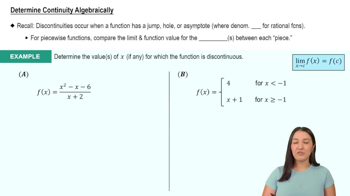
Step 1: Identify the function f(x) and analyze its form. If the function is not explicitly given, assume it is a piecewise function or a rational function, as these often have discontinuities.
Step 2: Determine the types of discontinuities that can occur. Common types include removable discontinuities (holes), jump discontinuities, and infinite discontinuities (vertical asymptotes).
Step 3: Check for points where the function is undefined within the interval (0, 5). For rational functions, set the denominator equal to zero and solve for x to find potential discontinuities.
Step 4: Apply the continuity checklist at each potential point of discontinuity: (a) The function must be defined at the point, (b) The limit of the function as x approaches the point from both sides must exist, and (c) The limit must equal the function's value at that point.
Step 5: For each point where the function is discontinuous, identify which condition(s) from the continuity checklist are violated. This will help classify the type of discontinuity present.
Verified video answer for a similar problem:
This video solution was recommended by our tutors as helpful for the problem above
Video duration:
5m
Play a video:
Was this helpful?
Key Concepts
Here are the essential concepts you must grasp in order to answer the question correctly.
Continuity of Functions
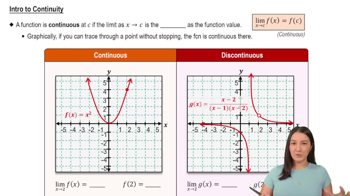
A function is continuous at a point if three conditions are met: the function is defined at that point, the limit of the function as it approaches that point exists, and the limit equals the function's value at that point. Understanding these conditions is crucial for identifying points of discontinuity.
Discontinuities can be classified into three main types: removable, jump, and infinite. A removable discontinuity occurs when a function can be made continuous by redefining a point, a jump discontinuity involves a sudden change in function value, and an infinite discontinuity occurs when the function approaches infinity at a point.
The continuity checklist is a systematic approach to determine if a function is continuous at a point. It includes checking if the function is defined at the point, if the limit exists, and if the limit equals the function's value. Violations of any of these conditions indicate a discontinuity.