Evaluate β«βΒ² 3πΒ² dπ and β«ββΒ² 3πΒ² dπ.
Verified step by step guidance
1
Step 1: Understand the problem. You are tasked with evaluating two definite integrals: β«βΒ² 3πΒ² dπ and β«ββΒ² 3πΒ² dπ. A definite integral calculates the area under the curve of the function within the specified limits.
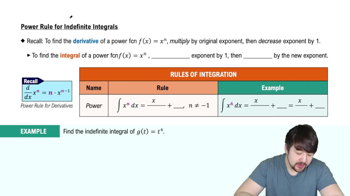
Step 2: Recall the formula for the integral of a power function. The integral of πβΏ with respect to π is (πβΏβΊΒΉ)/(n+1) + C, where C is the constant of integration. For definite integrals, the constant of integration is not needed because we evaluate the function at the limits.
Step 3: Apply the formula to the function 3πΒ². The integral of 3πΒ² is (3πΒ³)/3 = πΒ³. This simplifies the integral to β«βα΅ πΒ³ dπ, where 'a' and 'b' are the limits of integration.
Step 4: Evaluate the first integral β«βΒ² πΒ³ dπ. Substitute the upper limit (π = 2) and lower limit (π = 0) into the antiderivative πΒ³. Compute the difference: [πΒ³]βΒ² = (2Β³) - (0Β³).
Step 5: Evaluate the second integral β«ββΒ² πΒ³ dπ. Substitute the upper limit (π = 2) and lower limit (π = -2) into the antiderivative πΒ³. Compute the difference: [πΒ³]ββΒ² = (2Β³) - ((-2)Β³).
Verified video answer for a similar problem:
This video solution was recommended by our tutors as helpful for the problem above
Video duration:
2m
Play a video:
0 Comments
Key Concepts
Here are the essential concepts you must grasp in order to answer the question correctly.
Definite Integral
A definite integral represents the signed area under a curve defined by a function over a specific interval. It is calculated using the Fundamental Theorem of Calculus, which connects differentiation and integration. The limits of integration indicate the interval over which the area is calculated, and the result is a numerical value that reflects this area.
The Power Rule for Integration is a fundamental technique used to find the integral of polynomial functions. It states that the integral of x raised to the power n is (x^(n+1))/(n+1) + C, where n is not equal to -1. This rule simplifies the process of integrating functions like 3xΒ², making it easier to compute definite integrals.
Symmetry in integrals refers to the property that can simplify calculations, particularly when dealing with even and odd functions. An even function, f(x), satisfies f(-x) = f(x), and its integral over a symmetric interval around zero can be simplified. Conversely, an odd function satisfies f(-x) = -f(x), and its integral over a symmetric interval is zero, which can be useful in evaluating integrals like β«ββΒ² 3xΒ² dx.