

Limits and Continuity Repeat the instructions of Exercise 1 for
1 , x ≤ ―1 1/x , 0 < |x| < 1 ƒ(x) = { 0, x = 1 , 1 , x > 1 .
Verified step by step guidance
1
First, identify the piecewise function given: \( f(x) = \begin{cases} 1, & x \leq -1 \\ 1/x, & 0 < |x| < 1 \\ 0, & x = 1 \\ 1, & x > 1 \end{cases} \).
To analyze the limits and continuity, consider each interval separately. Start with \( x \leq -1 \), where \( f(x) = 1 \). The function is constant, so it is continuous in this interval.
Next, examine the interval \( 0 < |x| < 1 \), where \( f(x) = 1/x \). Check the limit as \( x \) approaches 0 from both sides. Since \( 1/x \) becomes unbounded as \( x \) approaches 0, the function is not continuous at \( x = 0 \).
Consider \( x = 1 \), where \( f(x) = 0 \). Evaluate the limit from the left and right of \( x = 1 \). From the left, \( f(x) = 1/x \) approaches 1, and from the right, \( f(x) = 1 \). Since the limits from both sides do not equal \( f(1) = 0 \), the function is not continuous at \( x = 1 \).
Finally, for \( x > 1 \), \( f(x) = 1 \). The function is constant, so it is continuous in this interval. Summarize the continuity: \( f(x) \) is continuous for \( x \leq -1 \) and \( x > 1 \), but not at \( x = 0 \) or \( x = 1 \).
Verified video answer for a similar problem:
This video solution was recommended by our tutors as helpful for the problem above
Video duration:
4m
Play a video:
Was this helpful?
Key Concepts
Here are the essential concepts you must grasp in order to answer the question correctly.
Limits
Limits are fundamental in calculus, describing the behavior of a function as its input approaches a particular point. Understanding limits is crucial for analyzing the function's behavior near points of interest, especially where the function may not be explicitly defined. In this context, limits help determine the value that f(x) approaches as x approaches specific values, such as -1, 0, or 1.
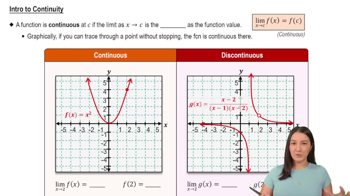
Continuity of a function at a point means that the function is defined at that point, the limit exists at that point, and the limit equals the function's value. A function is continuous over an interval if it is continuous at every point within that interval. For the given piecewise function, assessing continuity involves checking these conditions at the transition points x = -1, 0, and 1.
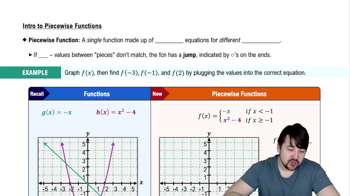
Piecewise functions are defined by different expressions over different intervals of the domain. Understanding how to evaluate and analyze these functions involves considering each piece separately and ensuring the function's overall behavior is consistent with the conditions of limits and continuity. In this problem, the function f(x) is defined differently over three intervals, requiring careful examination of each segment.