Explain why the function Ζ(π) = sin(1/π) has no continuous extension to π = 0.
Verified step by step guidance
1
To understand why the function Ζ(π) = sin(1/π) has no continuous extension to π = 0, we first need to consider the behavior of the function as π approaches 0. The function is defined for all π β 0, but we are interested in its behavior as π gets very close to 0.
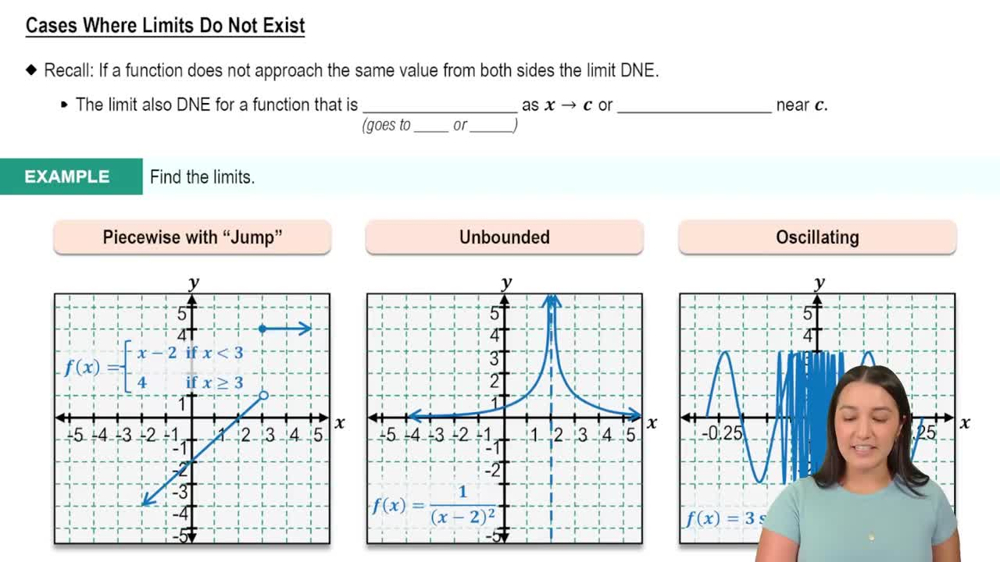
As π approaches 0, the expression 1/π becomes very large in magnitude, which means that the argument of the sine function oscillates rapidly between positive and negative values. This rapid oscillation causes the function Ζ(π) = sin(1/π) to oscillate between -1 and 1 without settling down to any particular value.
For a function to have a continuous extension at a point, the limit of the function as it approaches that point must exist and be finite. In this case, we need to check if the limit of Ζ(π) as π approaches 0 exists.
To determine the limit, consider the fact that for any sequence of values of π approaching 0, the corresponding sequence of values of 1/π will cover all real numbers densely. This means that the values of sin(1/π) will cover the interval [-1, 1] densely as well, without converging to a single value.
Since the limit of Ζ(π) as π approaches 0 does not exist (the function does not approach a single value), there is no way to define Ζ(0) such that the function becomes continuous at π = 0. Therefore, Ζ(π) = sin(1/π) has no continuous extension to π = 0.
Verified video answer for a similar problem:
This video solution was recommended by our tutors as helpful for the problem above
Video duration:
6m
Play a video:
Was this helpful?
Key Concepts
Here are the essential concepts you must grasp in order to answer the question correctly.
Limits
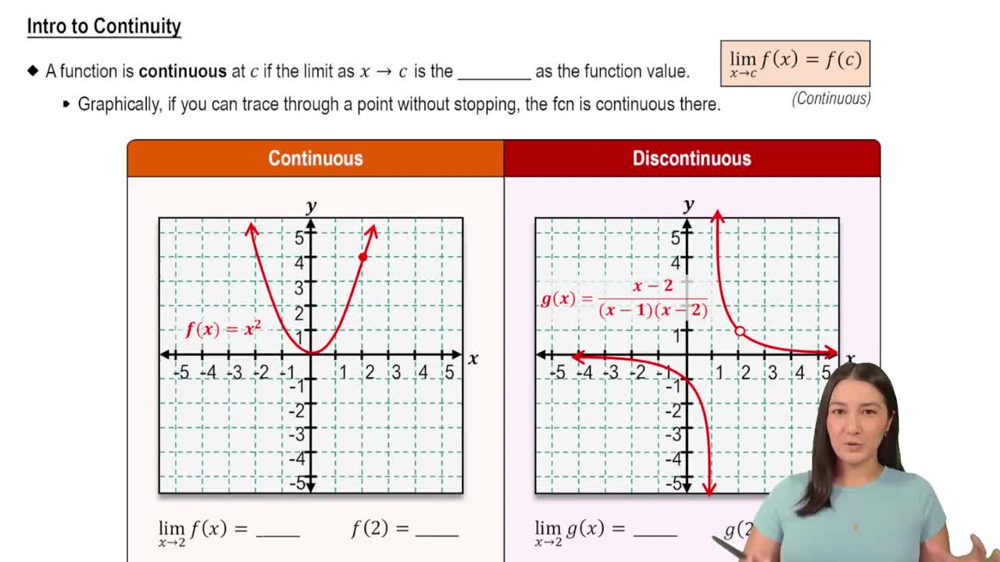
Limits are fundamental in calculus, representing the value that a function approaches as the input approaches a certain point. For the function Ζ(π) = sin(1/π), we need to analyze the limit as π approaches 0. If the limit does not exist or is not finite, the function cannot be continuously extended to that point.
A function is continuous at a point if the limit of the function as it approaches that point equals the function's value at that point. For Ζ(π) = sin(1/π}, we find that as π approaches 0, the function oscillates between -1 and 1, indicating that it does not settle at a single value, thus failing the continuity requirement at π = 0.
Oscillation refers to the behavior of a function that fluctuates between values without converging to a single limit. In the case of Ζ(π) = sin(1/π), as π approaches 0, the function oscillates infinitely between -1 and 1, which means it does not approach any specific value, preventing a continuous extension to π = 0.