62. Electronic Chips Suppose the probability that a particular computer chip fails after a hours of operation is 0.00005 ∫(from a to ∞) e^(-0.00005t) dt. a. Find the probability that the computer chip fails after 15,000 hr of operation.
Verified step by step guidance
1
Identify the given probability expression: the probability that the chip fails after \( a \) hours is given by \( 0.00005 \int_{a}^{\infty} e^{-0.00005t} \, dt \).
To find the probability that the chip fails after 15,000 hours, substitute \( a = 15000 \) into the integral: \( 0.00005 \int_{15000}^{\infty} e^{-0.00005t} \, dt \).
Evaluate the improper integral \( \int_{15000}^{\infty} e^{-0.00005t} \, dt \). Recall that the integral of \( e^{kt} \) with respect to \( t \) is \( \frac{1}{k} e^{kt} \), where \( k \) is a constant.
Apply the limits of integration from 15,000 to infinity. Since \( e^{-0.00005t} \) approaches zero as \( t \to \infty \), the upper limit contributes zero to the definite integral.
Multiply the result of the integral by 0.00005 to find the final probability expression for the chip failing after 15,000 hours.
Verified video answer for a similar problem:
This video solution was recommended by our tutors as helpful for the problem above
Video duration:
3m
Play a video:
0 Comments
Key Concepts
Here are the essential concepts you must grasp in order to answer the question correctly.
Improper Integrals
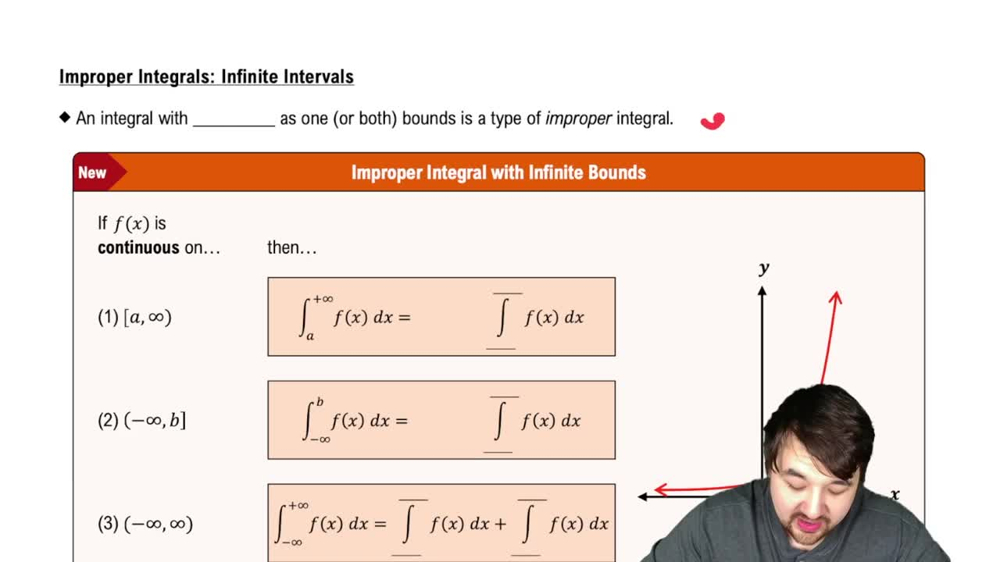
Improper integrals involve integration over an infinite interval or integrands with infinite discontinuities. In this problem, the integral from a finite value to infinity calculates the probability that the chip lasts beyond a certain time, requiring evaluation of an integral with an infinite upper limit.
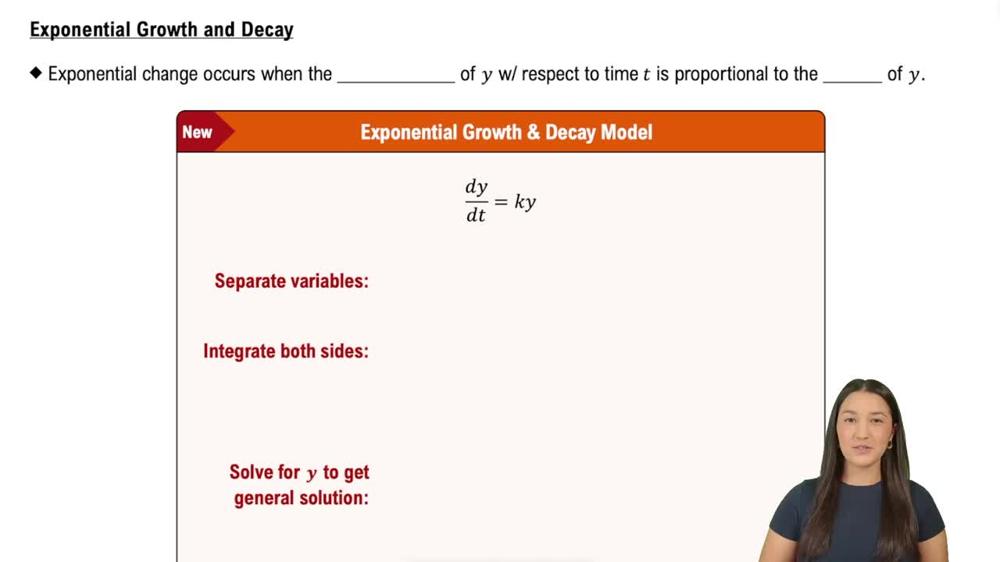
The function e^(-kt) models exponential decay, describing processes where quantities decrease at rates proportional to their current value. Here, it represents the decreasing probability density of chip failure over time, with the parameter 0.00005 controlling the decay rate.
Probability and Cumulative Distribution Function (CDF)
The integral of a probability density function (PDF) from a point to infinity gives the probability that a random variable exceeds that point. This is related to the survival function or complementary CDF, which in this case gives the probability the chip operates beyond a specified time.