7–58. Improper integrals Evaluate the following integrals or state that they diverge. 56. ∫ (from 0 to 1) 1/(x + √x) dx
Verified step by step guidance
1
First, analyze the integrand \( \frac{1}{x + \sqrt{x}} \) to check for any points of discontinuity or where the function might be undefined on the interval \([0,1]\). Notice that at \(x=0\), both \(x\) and \(\sqrt{x}\) are zero, so the denominator approaches zero, indicating a potential improper integral at the lower limit.
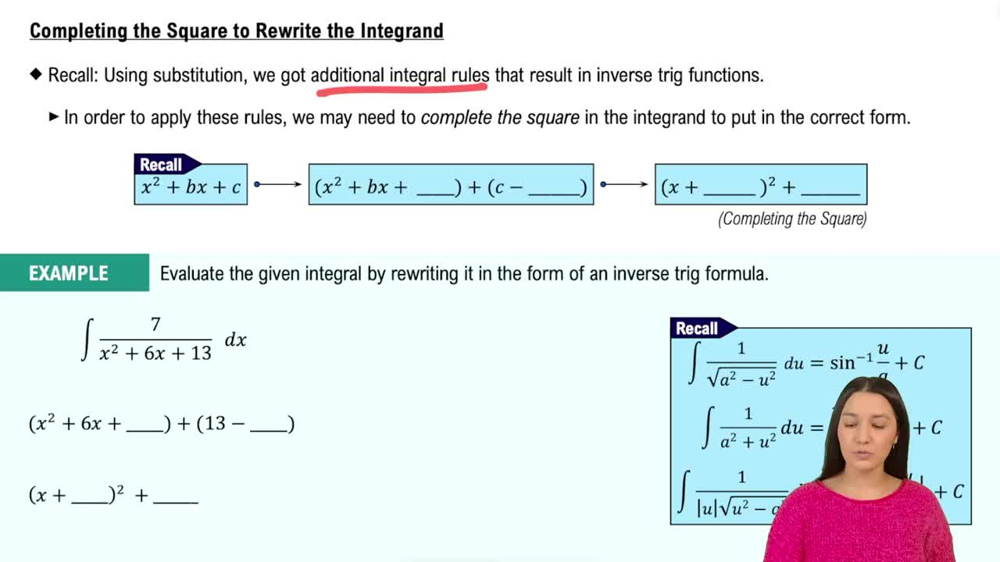
Rewrite the integrand to a simpler form to make it easier to integrate. Factor the denominator as \( x + \sqrt{x} = \sqrt{x}(\sqrt{x} + 1) \), so the integrand becomes \( \frac{1}{\sqrt{x}(\sqrt{x} + 1)} \).
Use a substitution to simplify the integral. Let \( t = \sqrt{x} \), which implies \( x = t^2 \) and \( dx = 2t \, dt \). Change the limits accordingly: when \( x=0 \), \( t=0 \); when \( x=1 \), \( t=1 \).
Rewrite the integral in terms of \( t \): \[ \int_0^1 \frac{1}{t(t+1)} \cdot 2t \, dt = \int_0^1 \frac{2t}{t(t+1)} \, dt = \int_0^1 \frac{2}{t+1} \, dt. \] This simplifies the integral significantly.
Now, integrate \( \int_0^1 \frac{2}{t+1} \, dt \) by recognizing it as a standard logarithmic integral. After integrating, evaluate the resulting expression at the limits \( t=0 \) and \( t=1 \) to find the value of the improper integral.
Verified video answer for a similar problem:
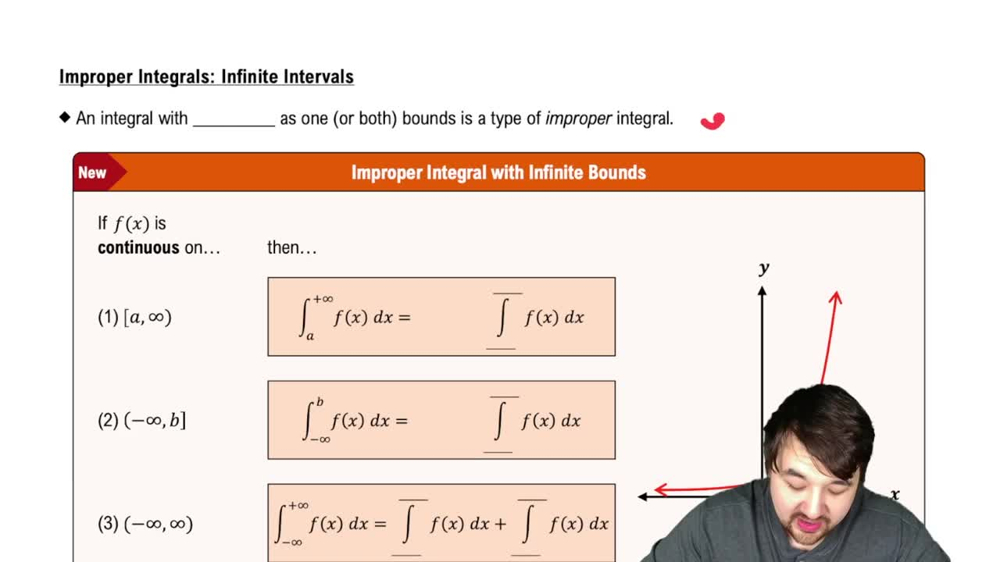
This video solution was recommended by our tutors as helpful for the problem above
Video duration:
4m
Play a video:
0 Comments
Key Concepts
Here are the essential concepts you must grasp in order to answer the question correctly.
Improper Integrals
Improper integrals involve integrals with infinite limits or integrands that become unbounded within the interval. To evaluate them, one often takes limits approaching the problematic points to determine convergence or divergence.
When the integrand has terms like 1/(x + √x), it may become unbounded near points where the denominator approaches zero. Analyzing the behavior near these points helps decide if the integral converges or diverges.
Simplifying the integrand using algebraic manipulation or substitution can make the integral easier to evaluate. For example, rewriting 1/(x + √x) in terms of a single variable substitution can facilitate integration.