Evaluate the following integrals. ∫ e³ˣ/(eˣ - 1) dx
Verified step by step guidance
1
Step 1: Recognize that the integral involves a fraction with exponential functions. To simplify, consider substituting a variable to make the integral more manageable. Let u = eˣ, which implies that du = eˣ dx.
Step 2: Rewrite the integral in terms of u. Since eˣ = u, the numerator becomes u³, and the denominator becomes u - 1. The dx term is replaced by du/u based on the substitution.
Step 3: The integral now becomes ∫ u³ / (u(u - 1)) du. Simplify the fraction to ∫ u² / (u - 1) du.
Step 4: To solve ∫ u² / (u - 1) du, consider polynomial long division or partial fraction decomposition to break the integrand into simpler terms. Perform the division or decomposition to express the integrand as a sum of simpler fractions.
Step 5: Integrate each term resulting from the decomposition or division separately. Use standard integration techniques, such as the natural logarithm for terms like 1/(u - 1) and power rule for polynomial terms. Finally, substitute back u = eˣ to express the solution in terms of x.
Verified video answer for a similar problem:
This video solution was recommended by our tutors as helpful for the problem above
Video duration:
4m
Play a video:
Was this helpful?
Key Concepts
Here are the essential concepts you must grasp in order to answer the question correctly.
Integration
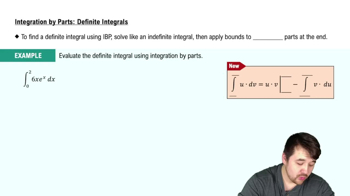
Integration is a fundamental concept in calculus that involves finding the integral of a function, which represents the area under the curve of that function. It is the reverse process of differentiation and can be used to calculate quantities such as total distance, area, and volume. Understanding the techniques of integration, including substitution and integration by parts, is essential for solving integral problems.
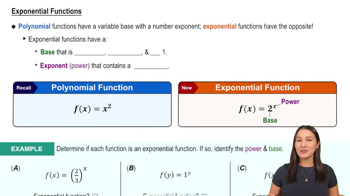
Exponential functions are mathematical functions of the form f(x) = a * e^(bx), where e is the base of natural logarithms, and a and b are constants. These functions grow rapidly and are characterized by their unique properties, such as the derivative of e^(x) being e^(x) itself. In the context of the given integral, recognizing the behavior of e^(3x) and e^(x) is crucial for simplifying the expression.
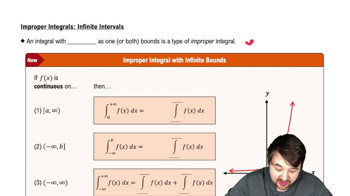
Improper integrals are integrals that involve infinite limits or integrands that approach infinity within the interval of integration. They require special techniques to evaluate, often involving limits to define the integral properly. In the case of the integral ∫ e^(3x)/(e^x - 1) dx, understanding how to handle potential singularities or discontinuities in the integrand is vital for finding a valid solution.