29–62. Integrals Evaluate the following integrals. Include absolute values only when needed.
∫ 3^{-2x} dx
Verified step by step guidance
1
Recognize that the integral involves an exponential function with base 3 and exponent \(-2x\). The integral is \(\int 3^{-2x} \, dx\).
Rewrite the integrand using the exponential function with base \(e\): \(3^{-2x} = e^{\ln(3^{-2x})} = e^{-2x \ln(3)}\).
Set \(a = -2 \ln(3)\) to simplify the expression, so the integral becomes \(\int e^{ax} \, dx\).
Recall the formula for integrating an exponential function: \(\int e^{ax} \, dx = \frac{1}{a} e^{ax} + C\), where \(C\) is the constant of integration.
Substitute back \(a = -2 \ln(3)\) and rewrite the answer in terms of the original base 3 exponential function to express the integral result.
Verified video answer for a similar problem:
This video solution was recommended by our tutors as helpful for the problem above
Video duration:
1m
Play a video:
0 Comments
Key Concepts
Here are the essential concepts you must grasp in order to answer the question correctly.
Integration of Exponential Functions
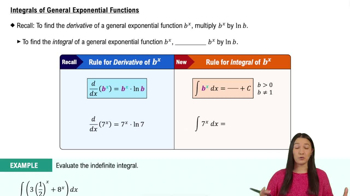
Integrating exponential functions involves finding the antiderivative of expressions where the variable is in the exponent. For functions like a^x, the integral is (a^x) / (ln a) plus a constant, provided a > 0 and a ≠ 1.
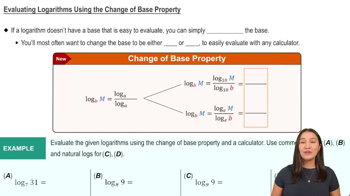
Logarithms, especially natural logs (ln), are essential when integrating exponential functions with bases other than e. Understanding that ln(a) is the natural logarithm of the base a helps in applying the integration formula correctly.
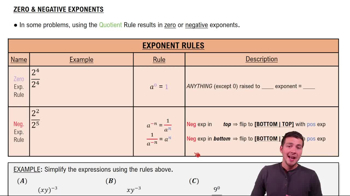
Negative exponents represent reciprocal powers, such as a^{-x} = 1 / a^x. Recognizing this helps in rewriting the integral or applying substitution methods to simplify the integration process.

 1:37 minutes
 Verified step by step guidance
 05:11
05:11