
7–40. Table look-up integrals Use a table of integrals to evaluate the following indefinite integrals. Some of the integrals require preliminary work, such as completing the square or changing variables, before they can be found in a table. 40. ∫ (e³ᵗ / √(4 + e²ᵗ)) dt
Verified step by step guidance
1
Step 1: Recognize that the integral ∫ (e³ᵗ / √(4 + e²ᵗ)) dt involves a combination of exponential and square root terms. To simplify, consider a substitution to reduce the complexity of the integrand.
Step 2: Let u = e²ᵗ. Then, compute the derivative of u with respect to t: du/dt = 2e²ᵗ. Rearrange to express dt in terms of du: dt = du / (2e²ᵗ).
Step 3: Substitute u = e²ᵗ into the integral. The term e³ᵗ can be rewritten as e²ᵗ * eᵗ, and e²ᵗ is replaced by u. The integral becomes ∫ (u * eᵗ / √(4 + u)) * (du / (2u)).
Step 4: Simplify the expression. Notice that eᵗ = √u (since u = e²ᵗ). Replace eᵗ with √u, and cancel out terms where possible. The integral now becomes ∫ (√u / √(4 + u)) * (du / 2).
Step 5: Factor out constants and rewrite the integral in a form that matches a standard table of integrals. The integral becomes (1/2) ∫ (√u / √(4 + u)) du. Use the table of integrals to find the solution or proceed with further simplifications if necessary.
Verified video answer for a similar problem:
This video solution was recommended by our tutors as helpful for the problem above
Video duration:
5m
Play a video:
Was this helpful?
Key Concepts
Here are the essential concepts you must grasp in order to answer the question correctly.
Indefinite Integrals
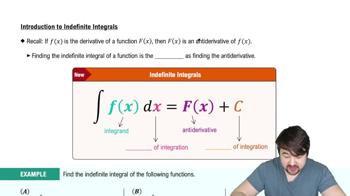
Indefinite integrals represent a family of functions whose derivative is the integrand. They are expressed without limits and include a constant of integration, typically denoted as 'C'. Understanding how to evaluate indefinite integrals is crucial for solving problems in calculus, as they provide the antiderivative of a function.
A table of integrals is a reference tool that lists common integrals and their corresponding antiderivatives. It simplifies the process of finding integrals by providing ready-made solutions for frequently encountered functions. Familiarity with this table allows students to quickly identify and apply the appropriate integral formulas.
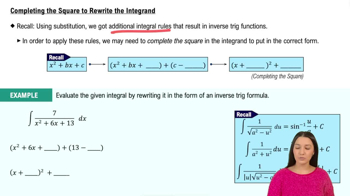
Completing the square is a technique used to transform a quadratic expression into a perfect square trinomial. This method is particularly useful in integration, as it can simplify the integrand, making it easier to evaluate. By rewriting expressions in this form, one can often apply standard integral formulas more effectively.