
Textbook Question
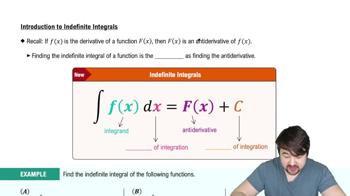
Give the antiderivatives of 1/x.
131
views

 Verified step by step guidance
 05:04
05:04
 06:18
06:18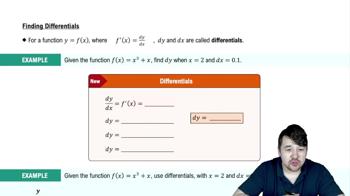 05:53
05:53Give the antiderivatives of 1/x.
Explain how to apply the First Derivative Test.
Graphing functions Use the guidelines of this section to make a complete graph of f.
f(x) = x⁴ + 4x³
{Use of Tech} Fixed points An important question about many functions concerns the existence and location of fixed points. A fixed point of f is a value of x that satisfies the equation f(x) = x; it corresponds to a point at which the graph of f intersects the line y = x. Find all the fixed points of the following functions. Use preliminary analysis and graphing to determine good initial approximations.
f(x) = cos x
Differentials Consider the following functions and express the relationship between a small change in x and the corresponding change in y in the form dy = f'(x)dx.
f(x) = sin² x
Suppose the position of an object moving horizontally after seconds is given by the function s(t) = 32t - t⁴, where 0 ≤ t ≤ 3 and s is measured in feet, with s > 0 corresponding to positions to the right of the origin. When is the object farthest to the right?