Compounded inflation The U.S. government reports the rate of inflation (as measured by the consumer index) both monthly and annually. Suppose for a particular month, the monthly rate of inflation is reported as 0.8%. Assuming this rate remains constant, what is the corresponding annual rate of inflation? Is the annual rate 12 times the monthly rate? Explain.
Table of contents
- 0. Functions7h 55m
- Introduction to Functions18m
- Piecewise Functions10m
- Properties of Functions9m
- Common Functions1h 8m
- Transformations5m
- Combining Functions27m
- Exponent rules32m
- Exponential Functions28m
- Logarithmic Functions24m
- Properties of Logarithms36m
- Exponential & Logarithmic Equations35m
- Introduction to Trigonometric Functions38m
- Graphs of Trigonometric Functions44m
- Trigonometric Identities47m
- Inverse Trigonometric Functions48m
- 1. Limits and Continuity2h 2m
- 2. Intro to Derivatives1h 33m
- 3. Techniques of Differentiation3h 18m
- 4. Applications of Derivatives2h 38m
- 5. Graphical Applications of Derivatives6h 2m
- 6. Derivatives of Inverse, Exponential, & Logarithmic Functions2h 37m
- 7. Antiderivatives & Indefinite Integrals1h 26m
- 8. Definite Integrals4h 44m
- 9. Graphical Applications of Integrals2h 27m
- 10. Physics Applications of Integrals 3h 16m
- 11. Integrals of Inverse, Exponential, & Logarithmic Functions2h 31m
- 12. Techniques of Integration7h 41m
- 13. Intro to Differential Equations2h 55m
- 14. Sequences & Series5h 36m
- 15. Power Series2h 19m
- 16. Parametric Equations & Polar Coordinates7h 58m
0. Functions
Exponential & Logarithmic Equations
Problem 7.3.1a
Textbook Question
In Exercises 1–4, solve for t.
1. a. e^(-0.3t) = 27
Verified step by step guidance1
Identify the equation given: \(e^{-0.3t} = 27\).
To solve for \(t\), take the natural logarithm (ln) of both sides to undo the exponential function: \(\ln\left(e^{-0.3t}\right) = \ln(27)\).
Use the logarithm property \(\ln\left(e^x\right) = x\) to simplify the left side: \(-0.3t = \ln(27)\).
Isolate \(t\) by dividing both sides of the equation by \(-0.3\): \(t = \frac{\ln(27)}{-0.3}\).
At this point, you can evaluate \(\ln(27)\) using a calculator and then perform the division to find the value of \(t\).
Verified video answer for a similar problem:This video solution was recommended by our tutors as helpful for the problem above
Video duration:
1mPlay a video:
Was this helpful?
Key Concepts
Here are the essential concepts you must grasp in order to answer the question correctly.
Exponential Functions
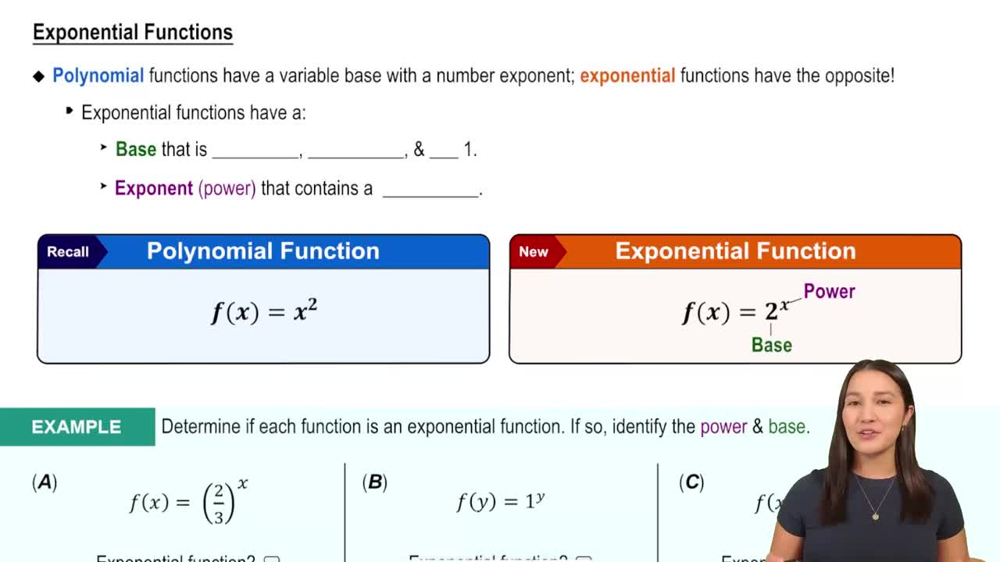
An exponential function has the form f(t) = a^t, where the variable is in the exponent. Understanding how to manipulate and interpret these functions is essential for solving equations like e^(-0.3t) = 27, where the unknown appears as an exponent.
Recommended video:
Exponential Functions
Natural Logarithm (ln)
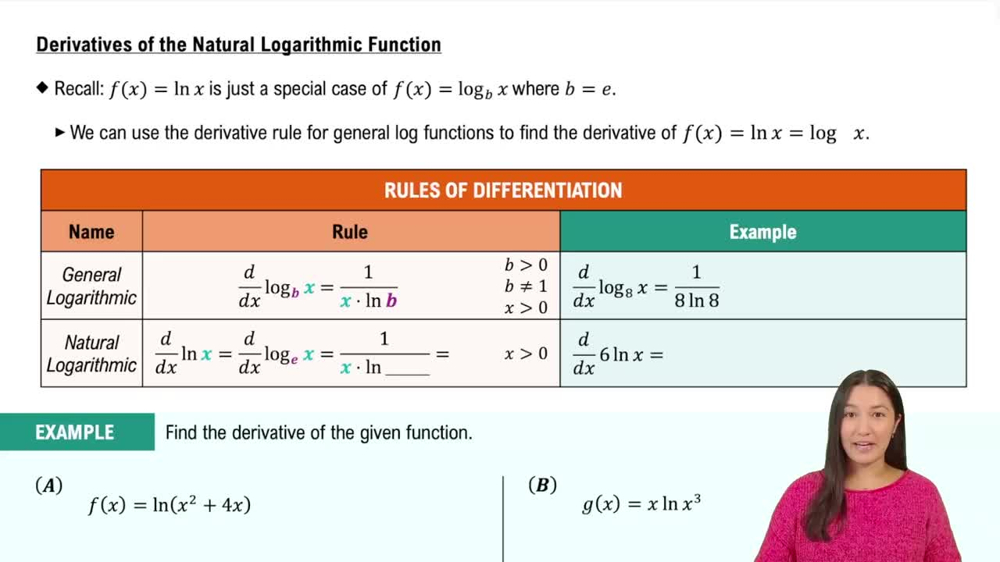
The natural logarithm is the inverse of the exponential function with base e. Applying the natural logarithm to both sides of an equation like e^(-0.3t) = 27 allows us to 'bring down' the exponent and solve for t.
Recommended video:
Derivative of the Natural Logarithmic Function
Solving Exponential Equations
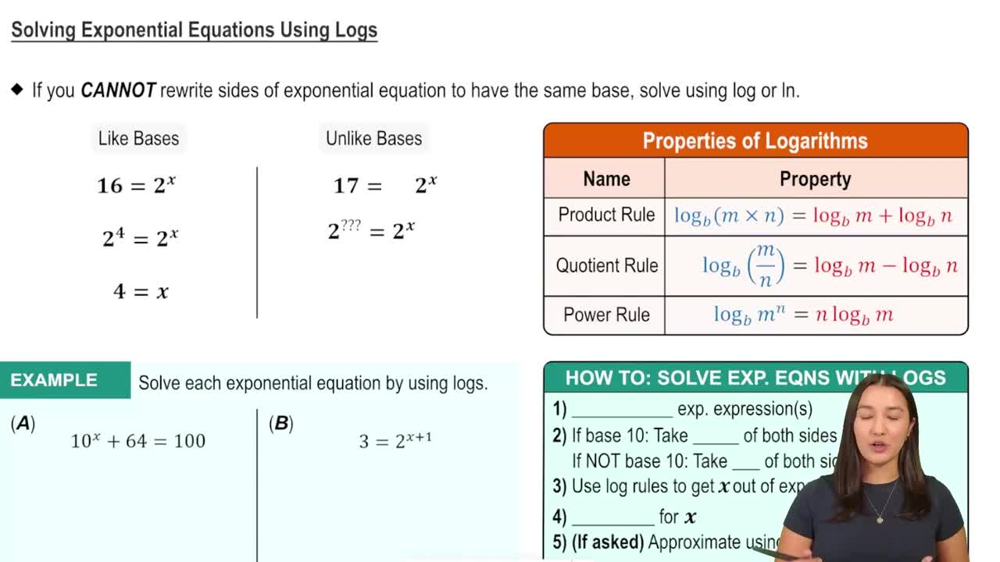
Solving exponential equations involves isolating the exponential term and then using logarithms to solve for the variable in the exponent. This process often requires properties of logarithms and careful algebraic manipulation.
Recommended video:
Solving Exponential Equations Using Logs
Watch next
Master Solving Exponential Equations Using Like Bases with a bite sized video explanation from Patrick
Start learningRelated Videos
Related Practice
Textbook Question
20
views