Ch. 2 - Limits
Briggs - Calculus: Early Transcendentals 3rd Edition
Briggs3rd EditionCalculus: Early TranscendentalsISBN: 9780136847243Not the one you use?Change textbook
Chapter 2, Problem 2.31a

A projectile is fired vertically upward and has a position given by s(t)=−16t^2+128t+192, for 0≤t≤9.


a. Graph the position function, for 0≤t≤9.

Verified step by step guidance
1
Step 1: Understand the position function s(t) = -16t^2 + 128t + 192, which represents the height of the projectile at time t. This is a quadratic function, indicating that the graph will be a parabola.
Step 2: Identify the key features of the parabola. The coefficient of t^2 is negative, so the parabola opens downwards. The vertex of the parabola will give the maximum height of the projectile.
Step 3: Find the vertex of the parabola. The vertex form of a quadratic function is given by t = -b/(2a), where a = -16 and b = 128. Substitute these values to find the time at which the maximum height occurs.
Step 4: Calculate the maximum height by substituting the time found in Step 3 back into the position function s(t). This will give the maximum height of the projectile.
Step 5: Plot the graph of the position function s(t) = -16t^2 + 128t + 192 for 0 ≤ t ≤ 9. Mark the vertex and the intercepts on the graph to visualize the trajectory of the projectile.

Verified video answer for a similar problem:

This video solution was recommended by our tutors as helpful for the problem above.
Video duration:
8m
Was this helpful?

Key Concepts

Here are the essential concepts you must grasp in order to answer the question correctly.

Quadratic Functions

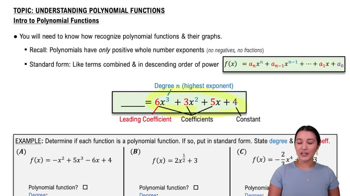
The position function s(t) = -16t^2 + 128t + 192 is a quadratic function, characterized by its parabolic shape. Quadratic functions can be expressed in the standard form ax^2 + bx + c, where a, b, and c are constants. The coefficient 'a' determines the direction of the parabola (upward or downward), while 'b' and 'c' affect its position and vertex.
Recommended video:
6:04
Introduction to Polynomial Functions

Graphing Techniques

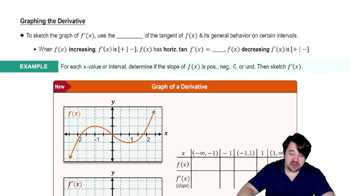
Graphing a quadratic function involves identifying key features such as the vertex, axis of symmetry, and intercepts. The vertex can be found using the formula t = -b/(2a), which gives the time at which the projectile reaches its maximum height. The x-intercepts (roots) can be found using the quadratic formula, and the y-intercept is simply the value of s(0).
Recommended video:
06:15
Graphing The Derivative

Projectile Motion

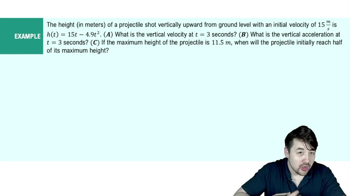
Projectile motion describes the motion of an object under the influence of gravity, typically modeled by a quadratic function. In this case, the function s(t) represents the height of the projectile over time, with the negative coefficient indicating that gravity is acting downward. Understanding the principles of projectile motion helps in analyzing the behavior of the object, including its maximum height and time of flight.
Recommended video:
06:51
Derivatives Applied To Acceleration Example 2