Find an equation of the tangent plane to the surface at the point .
Table of contents
- 0. Functions7h 55m
- Introduction to Functions18m
- Piecewise Functions10m
- Properties of Functions9m
- Common Functions1h 8m
- Transformations5m
- Combining Functions27m
- Exponent rules32m
- Exponential Functions28m
- Logarithmic Functions24m
- Properties of Logarithms36m
- Exponential & Logarithmic Equations35m
- Introduction to Trigonometric Functions38m
- Graphs of Trigonometric Functions44m
- Trigonometric Identities47m
- Inverse Trigonometric Functions48m
- 1. Limits and Continuity2h 2m
- 2. Intro to Derivatives1h 33m
- 3. Techniques of Differentiation3h 18m
- 4. Applications of Derivatives2h 38m
- 5. Graphical Applications of Derivatives6h 2m
- 6. Derivatives of Inverse, Exponential, & Logarithmic Functions2h 37m
- 7. Antiderivatives & Indefinite Integrals1h 26m
- 8. Definite Integrals4h 44m
- 9. Graphical Applications of Integrals2h 27m
- 10. Physics Applications of Integrals 3h 16m
- 11. Integrals of Inverse, Exponential, & Logarithmic Functions2h 31m
- 12. Techniques of Integration7h 41m
- 13. Intro to Differential Equations2h 55m
- 14. Sequences & Series5h 36m
- 15. Power Series2h 19m
- 16. Parametric Equations & Polar Coordinates7h 58m
2. Intro to Derivatives
Tangent Lines and Derivatives
Problem 8.9.100b
Textbook Question
The Eiffel Tower Property Let R be the region between the curves y = e^(-c·x) and y = -e^(-c·x) on the interval [a, ∞), where a ≥ 0 and c > 0.
The center of mass of R is located at (x̄, 0), where x̄ = [∫(a to ∞) x·e^(-c·x) dx] / [∫(a to ∞) e^(-c·x) dx]
(The profile of the Eiffel Tower is modeled by these two exponential curves; see the Guided Project ""The exponential Eiffel Tower"")
b. With a = 0 and c = 2, find the equations of the lines tangent to both curves at x = 0
Verified step by step guidance1
Identify the two curves given: the upper curve is \(y = e^{-2x}\) and the lower curve is \(y = -e^{-2x}\), since \(a = 0\) and \(c = 2\).
Find the derivative of the upper curve \(y = e^{-2x}\) with respect to \(x\) to determine the slope of the tangent line at \(x = 0\). Use the chain rule: \(\frac{dy}{dx} = -2e^{-2x}\).
Evaluate the slope of the tangent line at \(x = 0\) by substituting \(x = 0\) into the derivative: \(m = -2e^{0} = -2\).
Find the point of tangency on the upper curve at \(x = 0\): \(y = e^{0} = 1\). So the point is \((0, 1)\).
Use the point-slope form of a line \(y - y_1 = m(x - x_1)\) with the point \((0, 1)\) and slope \(-2\) to write the equation of the tangent line to the upper curve. Repeat the process for the lower curve \(y = -e^{-2x}\), noting that its derivative is \(\frac{dy}{dx} = 2e^{-2x}\) and the point at \(x=0\) is \((0, -1)\).
Verified video answer for a similar problem:This video solution was recommended by our tutors as helpful for the problem above
Video duration:
5mPlay a video:
Was this helpful?
Key Concepts
Here are the essential concepts you must grasp in order to answer the question correctly.
Exponential Functions and Their Properties
Exponential functions have the form y = e^(kx), where e is Euler's number and k is a constant. They exhibit rapid growth or decay depending on the sign of k. Understanding their behavior, especially at specific points like x = 0, is crucial for analyzing curves and their tangents.
Recommended video:
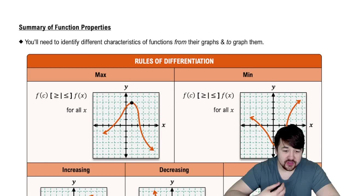
Properties of Functions
Derivative and Tangent Line Equation
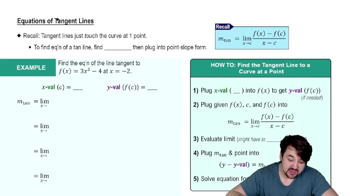
The derivative of a function at a point gives the slope of the tangent line there. To find the tangent line equation, compute the derivative at the point, then use the point-slope form: y - y₀ = m(x - x₀), where m is the slope and (x₀, y₀) is the point of tangency.
Recommended video:
Equations of Tangent Lines
Evaluating Definite Integrals with Infinite Limits
Integrals with limits extending to infinity are improper integrals and require limits to evaluate. For functions like e^(-cx), these integrals converge if c > 0. Understanding how to compute these integrals is essential for problems involving areas, centers of mass, or average values over infinite intervals.
Recommended video:
Definition of the Definite Integral
Watch next
Master Slopes of Tangent Lines with a bite sized video explanation from Patrick
Start learningRelated Videos
Related Practice
Multiple Choice
27
views