
Ch. 11 - Power Series
Briggs - Calculus: Early Transcendentals 3rd Edition
Briggs3rd EditionCalculus: Early TranscendentalsISBN: 9780136847243Not the one you use?Change textbook
Chapter 11, Problem 11.4.33

Differential equations


a. Find a power series for the solution of the following differential equations, subject to the given initial condition
b. Identify the function represented by the power series.


y′(t) − y = 0, y(0) = 2

Verified step by step guidance
1
Rewrite the differential equation in a form suitable for power series substitution: \(y'(t) - y(t) = 0\) with initial condition \(y(0) = 2\).
Assume a power series solution of the form \(y(t) = \sum_{n=0}^{\infty} a_n t^n\), where \(a_n\) are coefficients to be determined.
Differentiate the power series term-by-term to find \(y'(t) = \sum_{n=1}^{\infty} n a_n t^{n-1}\).
Substitute \(y(t)\) and \(y'(t)\) back into the differential equation to get \(\sum_{n=1}^{\infty} n a_n t^{n-1} - \sum_{n=0}^{\infty} a_n t^n = 0\).
Align powers of \(t\) by shifting indices as needed, then equate coefficients of like powers of \(t\) to form a recurrence relation for \(a_n\). Use the initial condition \(y(0) = a_0 = 2\) to find the coefficients.

Verified video answer for a similar problem:

This video solution was recommended by our tutors as helpful for the problem above.
Video duration:
4m
Was this helpful?

Key Concepts

Here are the essential concepts you must grasp in order to answer the question correctly.

Power Series Solutions to Differential Equations

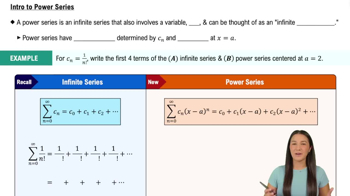
A power series solution expresses the solution of a differential equation as an infinite sum of powers of the independent variable. This method involves assuming a solution in the form of a series and determining the coefficients by substituting into the differential equation. It is especially useful when closed-form solutions are difficult to find.
Recommended video:
05:58
Intro to Power Series

Initial Conditions and Their Role

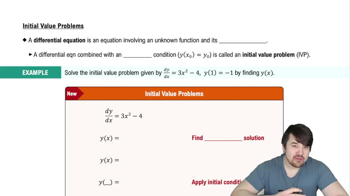
Initial conditions specify the value of the solution and possibly its derivatives at a particular point, allowing us to find unique coefficients in the power series. For example, y(0) = 2 sets the constant term in the series, ensuring the solution matches the given starting value.
Recommended video:
05:03
Initial Value Problems

Identifying Functions from Power Series

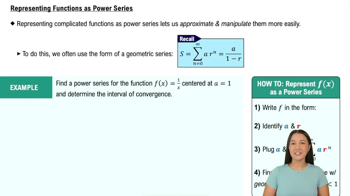
Once a power series solution is found, it can often be recognized as a known function by comparing it to standard series expansions (e.g., exponential, sine, cosine). This identification helps express the solution in a closed form, making it easier to interpret and use.
Recommended video:
07:32
Representing Functions as Power Series
Related Practice
Textbook Question

L'Hôpital's Rule by Taylor series Suppose f and g have Taylor series about the point a.

a. If f(a) = g(a) = 0 and g′(a) ≠ 0, evaluate lim ₓ→ₐ f(x)/g(x) by expanding f and g in their Taylor series. Show that the result is consistent withl’Hôpital’s Rule.

b. If f(a) = g(a) =f′(a) = g′(a) = 0 and g′′(a) ≠ 0, evaluate lim ₓ→ₐ f(x)/g(x) by expanding f and g in their Taylor series. Show that the result is consistent with two applications of 1'Hôpital's Rule.

55
views
Textbook Question

{Use of Tech} Approximating powers Compute the coefficients for the Taylor series for the following functions about the given point a, and then use the first four terms of the series to approximate the given number.

f(x) =∛x with a=64; approximate ∛60.

55
views
Textbook Question

Manipulating Taylor series Use the Taylor series in Table 11.5 to find the first four nonzero terms of the Taylor series for the following functions centered at 0.


sinh x²

79
views
Textbook Question

Remainders Find the remainder Rₙ for the nth−order Taylor polynomial centered at a for the given functions. Express the result for a general value of n.


f(x) = 1/(1 - x), a=0

72
views
Textbook Question

Manipulating Taylor series Use the Taylor series in Table 11.5 to find the first four nonzero terms of the Taylor series for the following functions centered at 0.


1/(1 − 2x)

86
views
Textbook Question

Working with binomial series Use properties of power series, substitution, and factoring to find the first four nonzero terms of the Maclaurin series for the following functions. Use the Maclaurin series


(1 + x)⁻² = 1 − 2x + 3x² − 4x³ + ⋯, for −1 < x < 1.


(1 + 4x)⁻²

59
views