
Textbook Question
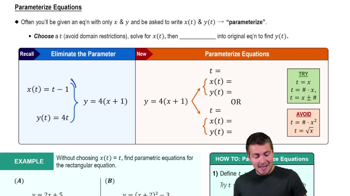
Multiple descriptions Which of the following parametric equations describe the same curve?
a. x = 2t², y = 4 + t; -4 ≤ t ≤ 4
b. x = 2t⁴, y = 4 + t²; -2 ≤ t ≤ 2
c. x = 2t^(2/3), y = 4 + t^(1/3); -64 ≤ t ≤ 64
44
views

 Verified step by step guidance
 08:02
08:02
 06:49
06:49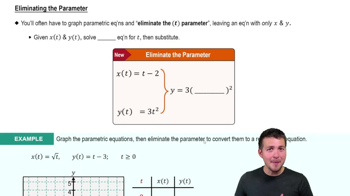 05:59
05:59Multiple descriptions Which of the following parametric equations describe the same curve?
a. x = 2t², y = 4 + t; -4 ≤ t ≤ 4
b. x = 2t⁴, y = 4 + t²; -2 ≤ t ≤ 2
c. x = 2t^(2/3), y = 4 + t^(1/3); -64 ≤ t ≤ 64
15–30. Working with parametric equations Consider the following parametric equations.
a. Eliminate the parameter to obtain an equation in x and y.
b. Describe the curve and indicate the positive orientation.
x = cos t, y = 1 + sin t; 0 ≤ t ≤ 2π
69–72. Tangent lines Find an equation of the line tangent to the following curves at the given point.
x² = -6y; (-6, -6)
37–52. Curves to parametric equations Find parametric equations for the following curves. Include an interval for the parameter values. Answers are not unique.
The segment of the parabola y=2x ²−4, where −1≤x≤5
93–94. Parametric equations of ellipses Find parametric equations (not unique) of the following ellipses (see Exercises 91–92). Graph the ellipse and find a description in terms of x and y.
An ellipse centered at (-2, -3) with major and minor axes of lengths 30 and 20, parallel to the x- and y-axes, respectively, generated counterclockwise (Hint: Shift the parametric equations.)
37–52. Curves to parametric equations Find parametric equations for the following curves. Include an interval for the parameter values. Answers are not unique.
The horizontal line segment starting at P(8, 2) and ending at Q(−2, 2)