Use calculus to find the arc length of the line segment x=3t+1, y=4t, for 0≤t≤1. Check your work by finding the distance between the endpoints of the line segment.
Table of contents
- 0. Functions7h 54m
- Introduction to Functions16m
- Piecewise Functions10m
- Properties of Functions9m
- Common Functions1h 8m
- Transformations5m
- Combining Functions27m
- Exponent rules32m
- Exponential Functions28m
- Logarithmic Functions24m
- Properties of Logarithms36m
- Exponential & Logarithmic Equations35m
- Introduction to Trigonometric Functions38m
- Graphs of Trigonometric Functions44m
- Trigonometric Identities47m
- Inverse Trigonometric Functions48m
- 1. Limits and Continuity2h 2m
- 2. Intro to Derivatives1h 33m
- 3. Techniques of Differentiation3h 18m
- 4. Applications of Derivatives2h 38m
- 5. Graphical Applications of Derivatives6h 2m
- 6. Derivatives of Inverse, Exponential, & Logarithmic Functions2h 37m
- 7. Antiderivatives & Indefinite Integrals1h 26m
- 8. Definite Integrals4h 44m
- 9. Graphical Applications of Integrals2h 27m
- 10. Physics Applications of Integrals 3h 16m
- 11. Integrals of Inverse, Exponential, & Logarithmic Functions2h 34m
- 12. Techniques of Integration7h 41m
- 13. Intro to Differential Equations2h 55m
- 14. Sequences & Series5h 36m
- 15. Power Series2h 19m
- 16. Parametric Equations & Polar Coordinates7h 58m
16. Parametric Equations & Polar Coordinates
Calculus with Parametric Curves
Problem 12.1.73
Textbook Question
73–76. Tangent lines Find an equation of the line tangent to the curve at the point corresponding to the given value of t.
x=t ²−1, y=t ³ +t; t=2
Verified step by step guidance1
Identify the parametric equations given: \(x = t^{2} - 1\) and \(y = t^{3} + t\), and the value of the parameter \(t = 2\) at which we want the tangent line.
Find the derivatives of \(x\) and \(y\) with respect to \(t\): compute \(\frac{dx}{dt}\) and \(\frac{dy}{dt}\). For \(x = t^{2} - 1\), \(\frac{dx}{dt} = 2t\). For \(y = t^{3} + t\), \(\frac{dy}{dt} = 3t^{2} + 1\).
Calculate the slope of the tangent line \(\frac{dy}{dx}\) at \(t=2\) using the chain rule for parametric equations: \(\frac{dy}{dx} = \frac{\frac{dy}{dt}}{\frac{dx}{dt}}\) evaluated at \(t=2\).
Find the coordinates of the point on the curve at \(t=2\) by substituting \(t=2\) into the parametric equations: \(x(2)\) and \(y(2)\).
Use the point-slope form of the line equation with the point \((x(2), y(2))\) and slope \(\frac{dy}{dx}\) to write the equation of the tangent line: \(y - y(2) = m (x - x(2))\), where \(m\) is the slope found in the previous step.
Verified video answer for a similar problem:This video solution was recommended by our tutors as helpful for the problem above
Video duration:
3mPlay a video:
Was this helpful?
Key Concepts
Here are the essential concepts you must grasp in order to answer the question correctly.
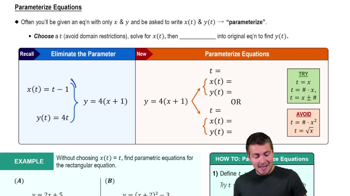
Parametric Equations
Parametric equations express the coordinates of points on a curve as functions of a parameter, often denoted as t. Here, x and y are given in terms of t, allowing us to analyze the curve's behavior by varying t.
Recommended video:
Guided course
Parameterizing Equations
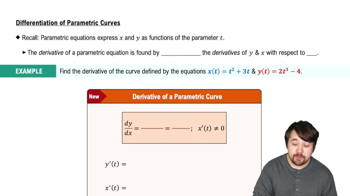
Derivative of Parametric Curves
To find the slope of the tangent line to a parametric curve, we compute dy/dx as (dy/dt) divided by (dx/dt). This ratio gives the instantaneous rate of change of y with respect to x at a specific parameter value.
Recommended video:
Differentiation of Parametric Curves
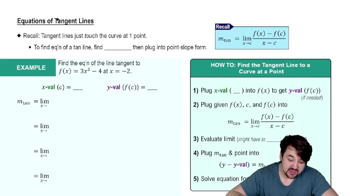
Equation of a Tangent Line
Once the slope of the tangent line and the point of tangency are known, the tangent line's equation can be written using the point-slope form: y - y₀ = m(x - x₀), where m is the slope and (x₀, y₀) is the point on the curve.
Recommended video:
Equations of Tangent Lines
Watch next
Master Differentiation of Parametric Curves with a bite sized video explanation from Patrick
Start learningRelated Videos
Related Practice
Textbook Question
7
views