
Find the remainder term Rₙ(x) for the Taylor series centered at 0 for the following functions. Find an upper bound for the magnitude of the remainder on the given interval for the given value of n. (The bound is not unique.)
ƒ(x) = ln (1 - x); bound R₃(x), for |x| < 1/2
Verified step by step guidance
1
Identify the function and the point about which the Taylor series is centered. Here, the function is \(f(x) = \ln(1 - x)\) and the series is centered at \$0$ (Maclaurin series).
Recall the general form of the remainder term (Lagrange form) for the Taylor series of order \(n\) centered at \$0\(:
\[R_n(x) = \frac{f^{(n+1)}(c)}{(n+1)!} x^{n+1}\]
where \)c\( is some value between \)0\( and \)x$.
Compute the derivatives of \(f(x)\) up to order \(n+1 = 4\). For \(f(x) = \ln(1 - x)\), the derivatives follow a pattern:
- \(f'(x) = -\frac{1}{1-x}\)
- \(f''(x) = -\frac{1}{(1-x)^2}\)
- \(f^{(3)}(x) = -\frac{2}{(1-x)^3}\)
- \(f^{(4)}(x) = -\frac{6}{(1-x)^4}\)
Use this to write \(f^{(4)}(c)\) explicitly.
Substitute \(f^{(4)}(c)\) into the remainder formula:
\[R_3(x) = \frac{f^{(4)}(c)}{4!} x^4 = \frac{-6}{4! (1 - c)^4} x^4\]
Simplify the factorial and constants.
To find an upper bound for \(|R_3(x)|\) on the interval \(|x| < \frac{1}{2}\), note that \(c\) lies between \$0\( and \)x\(, so \)|c| < \frac{1}{2}\(. Use this to find the maximum value of \)\frac{1}{|1 - c|^4}\( on this interval, then multiply by \)\frac{|x|^4}{4!}$ and the absolute value of the constant to get the bound.
Verified video answer for a similar problem:
This video solution was recommended by our tutors as helpful for the problem above
Video duration:
4m
Play a video:
Was this helpful?
Key Concepts
Here are the essential concepts you must grasp in order to answer the question correctly.
Taylor Series and Remainder Term
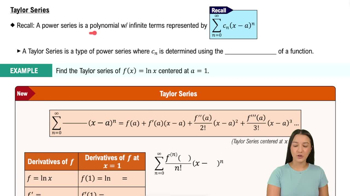
A Taylor series represents a function as an infinite sum of terms calculated from the derivatives at a single point. The remainder term Rₙ(x) measures the error between the function and its nth-degree Taylor polynomial, quantifying how well the polynomial approximates the function near the center.
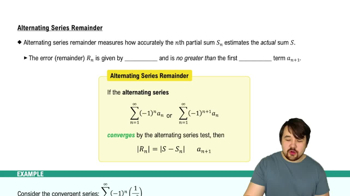
The Lagrange remainder provides an explicit formula for the error term Rₙ(x), involving the (n+1)th derivative evaluated at some point between the center and x. It helps estimate the maximum possible error by bounding the derivative on the interval of interest.
To find an upper bound for |Rₙ(x)|, identify the maximum absolute value of the (n+1)th derivative on the given interval and use it in the remainder formula. This approach ensures the error estimate holds for all x within the specified range, providing a practical measure of approximation accuracy.