
a. Find the Taylor polynomials of order n = 1 and n = 2 for the given functions centered at the given point a.
Verified step by step guidance
1
Identify the function and the center point: here, the function is \(f(x) = e^{x}\) and the center point is \(a = 0\).
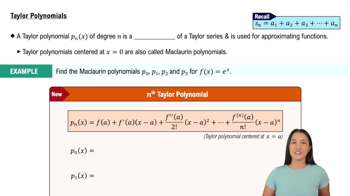
Recall the general formula for the Taylor polynomial of order \(n\) centered at \(a\):
\[T_n(x) = \sum_{k=0}^n \frac{f^{(k)}(a)}{k!} (x - a)^k,\]
where \(f^{(k)}(a)\) is the \(k\)-th derivative of \(f\) evaluated at \(a\).
Calculate the derivatives of \(f(x) = e^{x}\) and evaluate them at \(a=0\):
- \(f(x) = e^{x}\), so \(f(0) = e^{0} = 1\),
- \(f'(x) = e^{x}\), so \(f'(0) = 1\),
- \(f''(x) = e^{x}\), so \(f''(0) = 1\).
Write the Taylor polynomial of order \(n=1\) using the formula:
\[T_1(x) = f(0) + f'(0)(x - 0) = 1 + 1 \cdot x = 1 + x.\]
Write the Taylor polynomial of order \(n=2\) using the formula:
\[T_2(x) = f(0) + f'(0)(x - 0) + \frac{f''(0)}{2!}(x - 0)^2 = 1 + x + \frac{1}{2} x^2.\]
Verified video answer for a similar problem:
This video solution was recommended by our tutors as helpful for the problem above
Video duration:
2m
Play a video:
Was this helpful?
Key Concepts
Here are the essential concepts you must grasp in order to answer the question correctly.
Taylor Polynomials
Taylor polynomials approximate a function near a point using a finite sum of its derivatives at that point. The nth-order Taylor polynomial includes terms up to the nth derivative, providing increasingly accurate approximations as n increases.
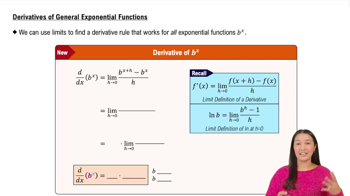
The function f(x) = e^x has the unique property that all its derivatives are equal to e^x. This simplifies finding Taylor polynomials since each derivative evaluated at a point a is e^a, making the polynomial terms straightforward to compute.
Centering a Taylor polynomial at a point a means the polynomial approximates the function near x = a. The polynomial uses (x - a) as the variable, ensuring the approximation is most accurate close to this center.