
Ch.12 - Parametric and Polar Curves
Briggs - Calculus: Early Transcendentals 3rd Edition
Briggs3rd EditionCalculus: Early TranscendentalsISBN: 9780136847243Not the one you use?Change textbook
Chapter 12, Problem 12.R.2

Eliminate the parameter in the parametric equations x=1+sin t, y=3+2 sin t, for 0≤t≤π/2, and describe the curve, indicating its positive orientation. How does this curve differ from the curve x=1+sin t, y=3+2 sin t, for π/2≤t≤π?

Verified step by step guidance
1
Start by writing down the given parametric equations: \(x = 1 + \sin t\) and \(y = 3 + 2 \sin t\), with the parameter \(t\) in the interval \(0 \leq t \leq \frac{\pi}{2}\).
Express \(\sin t\) from the first equation: \(\sin t = x - 1\).
Substitute \(\sin t = x - 1\) into the second equation to eliminate the parameter \(t\): \(y = 3 + 2(x - 1)\).
Simplify the resulting equation to get the Cartesian form of the curve: \(y = 3 + 2x - 2\) which simplifies to \(y = 2x + 1\).
To describe the curve's positive orientation, consider the interval \(0 \leq t \leq \frac{\pi}{2}\) where \(\sin t\) increases from 0 to 1, so \(x\) increases from 1 to 2 and \(y\) increases from 3 to 5. For the interval \(\frac{\pi}{2} \leq t \leq \pi\), \(\sin t\) decreases from 1 back to 0, so the curve is traced in the opposite direction, moving from \((2,5)\) back to \((1,3)\).

Verified video answer for a similar problem:

This video solution was recommended by our tutors as helpful for the problem above.
Video duration:
1m
Was this helpful?

Key Concepts

Here are the essential concepts you must grasp in order to answer the question correctly.

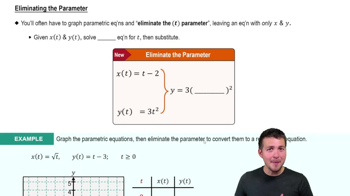
Eliminating the Parameter in Parametric Equations

Eliminating the parameter involves expressing one variable directly in terms of the other, removing the parameter (t). This is done by solving one parametric equation for the parameter and substituting into the other, resulting in a Cartesian equation that describes the curve.
Recommended video:
Guided course
05:59
Eliminating the Parameter

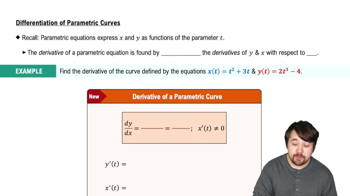
Understanding the Domain and Orientation of Parametric Curves

The domain of the parameter t determines which portion of the curve is traced. Orientation refers to the direction in which the curve is drawn as t increases. Different intervals of t can produce different segments or directions on the same curve.
Recommended video:
06:49
Differentiation of Parametric Curves

Analyzing Curve Differences Based on Parameter Intervals

Changing the interval of t can alter the part of the curve traced and its orientation. Comparing curves for different t-intervals helps identify how the shape, position, and direction of traversal differ, even if the parametric formulas are similar.
Recommended video:
02:59
Finding Area Between Curves that Cross on the Interval