Ch. 3 - Derivatives
Hass - Thomas' Calculus 15th Edition
Hass15th EditionThomas' CalculusISBN: 9780137616077Not the one you use?Change textbook
Chapter 3, Problem 3.4.9

Free-Fall Applications
Free fall on Mars and Jupiter The equations for free fall at the surfaces of Mars and Jupiter (s in meters, t in seconds) are s = 1.86t² on Mars and s = 11.44t² on Jupiter. How long does it take a rock falling from rest to reach a velocity of 27.8 m/sec (about 100 km/h) on each planet?

Verified step by step guidance
1
Start by understanding the relationship between position, velocity, and acceleration in free fall. The position function s(t) gives the distance fallen over time, and the derivative of this function with respect to time, s'(t), gives the velocity.
For Mars, the position function is s = 1.86t². To find the velocity function, take the derivative of s with respect to t: s'(t) = d/dt(1.86t²).
Calculate the derivative: s'(t) = 2 * 1.86 * t = 3.72t. This is the velocity function for Mars.
Set the velocity function equal to the desired velocity, 27.8 m/sec, and solve for t: 3.72t = 27.8. This will give you the time it takes for the rock to reach 27.8 m/sec on Mars.
Repeat the process for Jupiter. The position function is s = 11.44t². Take the derivative to find the velocity function: s'(t) = 2 * 11.44 * t = 22.88t. Set 22.88t = 27.8 and solve for t to find the time it takes on Jupiter.

Verified video answer for a similar problem:

This video solution was recommended by our tutors as helpful for the problem above.
Video duration:
3m
Was this helpful?

Key Concepts

Here are the essential concepts you must grasp in order to answer the question correctly.

Free Fall Motion

Free fall motion refers to the movement of an object under the influence of gravitational force alone, without any other forces acting on it. The distance an object falls is proportional to the square of the time it has been falling, as shown by the equations s = 1.86t² for Mars and s = 11.44t² for Jupiter. Understanding this concept is crucial for analyzing the motion of objects in different gravitational fields.
Recommended video:
06:29
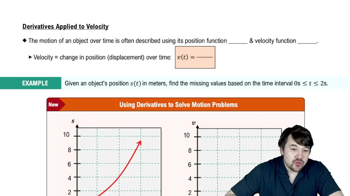
Derivatives Applied To Velocity

Velocity in Free Fall

Velocity in free fall is the rate of change of position with respect to time, influenced by gravity. For an object starting from rest, its velocity can be determined by differentiating the position function with respect to time. In this problem, the goal is to find the time it takes for a rock to reach a specific velocity, 27.8 m/sec, on Mars and Jupiter, requiring an understanding of how velocity relates to the position function.
Recommended video:
06:29
Derivatives Applied To Velocity

Differentiation

Differentiation is a fundamental concept in calculus used to find the rate at which a quantity changes. In the context of free fall, differentiating the position function s = 1.86t² or s = 11.44t² with respect to time gives the velocity function. This process allows us to determine the time required for the rock to reach a given velocity by setting the derivative equal to the desired velocity and solving for time.
Recommended video:
05:53
Finding Differentials