
Launching a Rocket When a model rocket is launched, the propellant burns for a few seconds, accelerating the rocket upward. After burnout, the rocket coasts upward for a while and then begins to fall. A small explosive charge pops out a parachute shortly after the rocket starts down. The parachute slows the rocket to keep it from breaking when it lands.
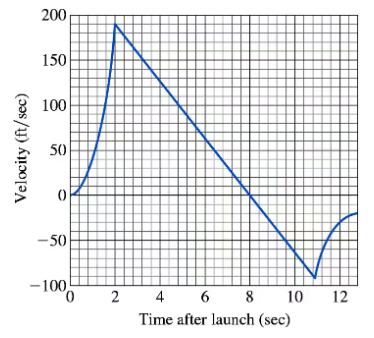
The figure here shows velocity data from the flight of the model rocket. Use the data to answer the following.
b. For how many seconds did the engine burn?
Verified step by step guidance
1
Examine the graph to identify the period during which the rocket is accelerating upwards. This is indicated by a positive slope in the velocity-time graph.
Notice that the velocity increases from 0 ft/sec to a peak value, indicating the engine is burning and accelerating the rocket.
Determine the time interval from the start (0 seconds) to the point where the velocity reaches its maximum value. This is the duration of the engine burn.
On the graph, locate the time at which the velocity reaches its maximum value. This is where the slope changes from positive to negative, indicating the end of the engine burn.
Read the time value at this point from the x-axis. This time value represents the number of seconds the engine burned.
Verified video answer for a similar problem:
This video solution was recommended by our tutors as helpful for the problem above
Video duration:
3m
Play a video:
0 Comments
Key Concepts
Here are the essential concepts you must grasp in order to answer the question correctly.
Velocity-Time Graphs
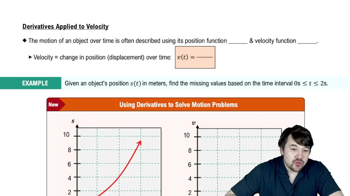
A velocity-time graph illustrates how an object's velocity changes over time. The vertical axis represents velocity, while the horizontal axis represents time. The slope of the graph indicates acceleration, and the area under the curve represents displacement. Understanding this graph is crucial for analyzing the motion of the rocket during its flight.
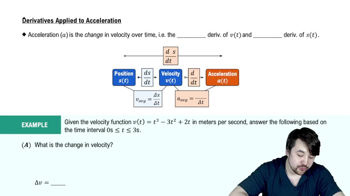
Acceleration is the rate of change of velocity with respect to time. It can be positive (speeding up) or negative (slowing down). In the context of the rocket, acceleration occurs during the engine burn phase, where the rocket's velocity increases. Identifying the duration of the engine burn involves determining the time interval during which the velocity is increasing.
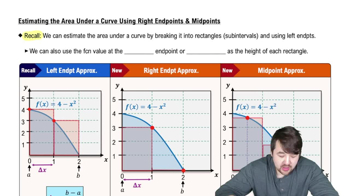
The area under a velocity-time graph represents the displacement of the object over a given time interval. In this scenario, calculating the area under the curve can help determine how far the rocket traveled during its ascent and descent. This concept is essential for understanding the overall motion of the rocket and answering questions related to its flight.