
Suppose f is differentiable on (-∞,∞), f(1) = 2, and f'(1) = 3. Find the linear approximation to f at x = 1 and use it to approximate f (1.1).
Verified step by step guidance
1
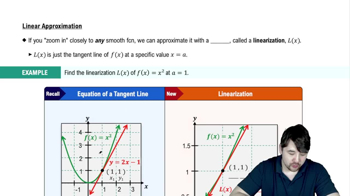
To find the linear approximation of a function f at a point x = a, we use the formula for the tangent line: L(x) = f(a) + f'(a)(x - a).
In this problem, we are given that f(1) = 2 and f'(1) = 3. So, we will use these values to find the linear approximation at x = 1.
Substitute a = 1, f(1) = 2, and f'(1) = 3 into the formula: L(x) = 2 + 3(x - 1).
Now, simplify the expression for L(x): L(x) = 2 + 3x - 3, which simplifies to L(x) = 3x - 1.
To approximate f(1.1), substitute x = 1.1 into the linear approximation: L(1.1) = 3(1.1) - 1.
Verified video answer for a similar problem:
This video solution was recommended by our tutors as helpful for the problem above
Video duration:
1m
Play a video:
Was this helpful?
Key Concepts
Here are the essential concepts you must grasp in order to answer the question correctly.
Differentiability
A function is differentiable at a point if it has a defined derivative at that point, meaning it has a tangent line. This implies that the function is continuous at that point and that the slope of the tangent line represents the instantaneous rate of change of the function. Differentiability is crucial for applying linear approximations.
Linear approximation uses the tangent line at a specific point to estimate the value of a function near that point. The formula for linear approximation is f(x) ≈ f(a) + f'(a)(x - a), where 'a' is the point of tangency. This method simplifies calculations by providing a quick way to estimate function values using derivatives.
The tangent line to a function at a given point is a straight line that touches the function at that point and has the same slope as the function at that point. It is represented by the equation y = f'(a)(x - a) + f(a), where 'a' is the point of tangency. The tangent line is essential for linear approximation, as it provides the best linear estimate of the function's behavior near 'a'.