Ch. 4 - Applications of Derivatives
Hass - Thomas' Calculus 15th Edition
Hass15th EditionThomas' CalculusISBN: 9780137616077Not the one you use?Change textbook
Chapter 4, Problem 4.4.119

119. Find the values of constants a, b, and c such that the graph of y = ax^3 + bx^2 + cx has a
local maximum at x = 3, local minimum at x =- 1, and inflection point at (1, 11).

Verified step by step guidance
1
To find the values of a, b, and c, start by using the conditions for local maxima and minima. The first derivative of the function y = ax^3 + bx^2 + cx is y' = 3ax^2 + 2bx + c. Set y'(3) = 0 for the local maximum at x = 3, and y'(-1) = 0 for the local minimum at x = -1.
Next, use the condition for the inflection point. The second derivative of the function is y'' = 6ax + 2b. Set y''(1) = 0 to find the inflection point at x = 1.
Substitute x = 3 into y' = 3ax^2 + 2bx + c to get the equation 27a + 6b + c = 0. This is the first equation.
Substitute x = -1 into y' = 3ax^2 + 2bx + c to get the equation 3a - 2b + c = 0. This is the second equation.
Substitute x = 1 into y'' = 6ax + 2b to get the equation 6a + 2b = 0. This is the third equation. Solve this system of equations to find the values of a, b, and c.

Verified video answer for a similar problem:

This video solution was recommended by our tutors as helpful for the problem above.
Video duration:
7m

Key Concepts

Here are the essential concepts you must grasp in order to answer the question correctly.

Critical Points and Derivatives

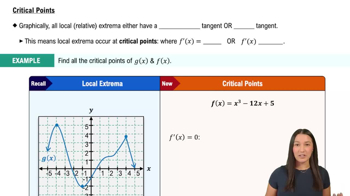
Critical points occur where the first derivative of a function is zero or undefined, indicating potential local maxima or minima. To find these points for the function y = ax^3 + bx^2 + cx, compute the first derivative and set it to zero. Solving this will help identify the x-values where the local maximum and minimum occur, which are given as x = 3 and x = -1.
Recommended video:
04:50
Critical Points

Second Derivative Test

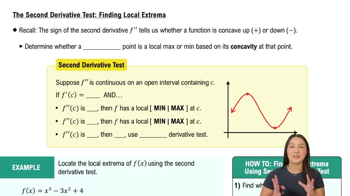
The second derivative test helps determine the nature of critical points. If the second derivative at a critical point is positive, the point is a local minimum; if negative, it's a local maximum. For the function y = ax^3 + bx^2 + cx, evaluate the second derivative at x = 3 and x = -1 to confirm the local maximum and minimum, respectively.
Recommended video:
06:02
The Second Derivative Test: Finding Local Extrema

Inflection Points

An inflection point is where the function changes concavity, identified by setting the second derivative to zero and confirming a sign change. For y = ax^3 + bx^2 + cx, the inflection point is given at (1, 11). Ensure the second derivative equals zero at x = 1 and verify the function's value at this point matches the y-coordinate of the inflection point.
Recommended video:
04:50
Critical Points