Ch. 10 - Sequences and Infinite Series
Briggs - Calculus: Early Transcendentals 3rd Edition
Briggs3rd EditionCalculus: Early TranscendentalsISBN: 9780136847243Not the one you use?Change textbook
Chapter 10, Problem 10.6.59

45–63. Absolute and conditional convergence Determine whether the following series converge absolutely, converge conditionally, or diverge.
∑ (k = 1 to ∞) (−1)ᵏ · tan⁻¹(k) / k³

Verified step by step guidance
1
Identify the given series: \( \sum_{k=1}^{\infty} (-1)^k \frac{\tan^{-1}(k)}{k^3} \). This is an alternating series because of the factor \( (-1)^k \).
Check the absolute convergence by considering the series of absolute values: \( \sum_{k=1}^{\infty} \left| \frac{\tan^{-1}(k)}{k^3} \right| = \sum_{k=1}^{\infty} \frac{\tan^{-1}(k)}{k^3} \). Since \( \tan^{-1}(k) \) is positive for all positive \( k \), the absolute value removes the alternating sign.
Analyze the behavior of \( \tan^{-1}(k) \) as \( k \to \infty \). Recall that \( \tan^{-1}(k) \) approaches \( \frac{\pi}{2} \), a finite constant, so for large \( k \), \( \frac{\tan^{-1}(k)}{k^3} \) behaves like \( \frac{\pi/2}{k^3} \).
Compare the absolute value series to the p-series \( \sum \frac{1}{k^3} \), which converges because \( p = 3 > 1 \). By the Comparison Test, the absolute value series converges.
Since the series converges absolutely, conclude that the original alternating series converges absolutely as well.

Verified video answer for a similar problem:

This video solution was recommended by our tutors as helpful for the problem above.
Video duration:
6m
Was this helpful?

Key Concepts

Here are the essential concepts you must grasp in order to answer the question correctly.

Absolute Convergence

A series ∑a_k converges absolutely if the series of absolute values ∑|a_k| converges. Absolute convergence guarantees convergence regardless of the sign of terms, and it often simplifies analysis by allowing the use of comparison tests on positive terms.
Recommended video:
07:51
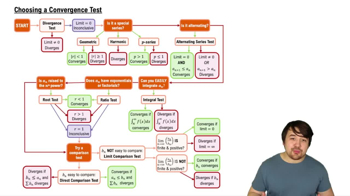
Choosing a Convergence Test

Conditional Convergence

A series converges conditionally if it converges, but does not converge absolutely. This means ∑a_k converges, but ∑|a_k| diverges. Conditional convergence often occurs in alternating series where the terms decrease in magnitude and approach zero.
Recommended video:
07:51
Choosing a Convergence Test

Alternating Series Test and Behavior of arctan(k)/k³

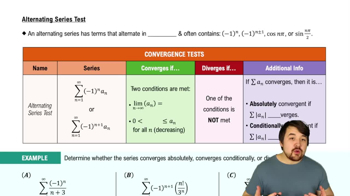
The Alternating Series Test states that if the absolute value of terms decreases monotonically to zero, the alternating series converges. Here, tan⁻¹(k)/k³ decreases to zero as k grows large, so this test helps determine conditional convergence by analyzing term behavior and sign alternation.
Recommended video:
10:54
Alternating Series Test