Ch. 1 - Functions
Hass - Thomas' Calculus 15th Edition
Hass15th EditionThomas' CalculusISBN: 9780137616077Not the one you use?Change textbook
Chapter 1, Problem 54e

Describe how each graph is obtained from the graph of 𝔂 = ƒ(x).


e. 𝔂 = ƒ( x ) - 4
3

Verified step by step guidance
1
Start with the graph of the function 𝔂 = ƒ(x). This is your base graph from which transformations will be applied.
The expression 𝔂 = ƒ(x) - 4 indicates a vertical shift. Specifically, subtracting 4 from the function means you will shift the entire graph of 𝔂 = ƒ(x) downward by 4 units.
To visualize this, take each point (x, y) on the original graph of 𝔂 = ƒ(x) and move it to the point (x, y - 4). This will lower every point on the graph by 4 units.
Ensure that the shape and orientation of the graph remain unchanged; only the vertical position is altered.
After applying the vertical shift, the new graph represents the function 𝔂 = ƒ(x) - 4, which is the original graph moved down by 4 units.

Verified video answer for a similar problem:

This video solution was recommended by our tutors as helpful for the problem above.
Video duration:
5m
Was this helpful?

Key Concepts

Here are the essential concepts you must grasp in order to answer the question correctly.

Vertical Shifts

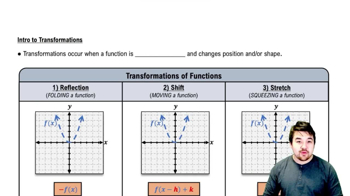
Vertical shifts occur when a constant is added to or subtracted from a function. In the case of 𝔶 = ƒ(x) - 4, the graph of ƒ(x) is shifted downward by 4 units. This transformation affects the y-coordinates of all points on the graph, while the x-coordinates remain unchanged.
Recommended video:
5:25
Intro to Transformations

Function Notation

Function notation, such as ƒ(x), represents a relationship where each input x corresponds to exactly one output y. Understanding this notation is crucial for interpreting how changes to the function, like subtracting a constant, affect the overall graph. It allows for clear communication of mathematical ideas and transformations.
Recommended video:
04:22
Sigma Notation

Graph Transformations

Graph transformations refer to the various ways a function's graph can be altered, including shifts, stretches, and reflections. In this case, the transformation involves a vertical shift, which is a fundamental concept in understanding how the graph of a function can be manipulated without changing its shape.
Recommended video:
5:25
Intro to Transformations