Centroid: Find the centroid of the region bounded by the x-axis, the curve y = csc x, and the lines x = π/6, x = 5π/6.
Ch. 8 - Techniques of Integration
Chapter 8, Problem 8.8.83
Exercises 83–86 are about the infinite region in the first quadrant between the curve y = e^(-x) and the x-axis.
83. Find the area of the region.
Verified step by step guidance1
Identify the region whose area you want to find. Here, it is the area in the first quadrant bounded by the curve \(y = e^{-x}\) and the x-axis.
Set up the definite integral to find the area. Since the region is in the first quadrant and bounded by the x-axis, the limits of integration for \(x\) are from 0 to \(\infty\). The area \(A\) can be expressed as \(A = \int_0^{\infty} e^{-x} \, dx\).
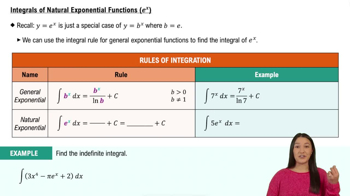
Recall the integral formula for the exponential function: \(\int e^{ax} \, dx = \frac{1}{a} e^{ax} + C\) for \(a \neq 0\). In this case, \(a = -1\).
Evaluate the improper integral by taking the limit as the upper bound approaches infinity: \(A = \lim_{t \to \infty} \int_0^t e^{-x} \, dx\).
Compute the definite integral using the antiderivative and then apply the limit to find the area.

Verified video answer for a similar problem:
This video solution was recommended by our tutors as helpful for the problem above.
Video duration:
8mWas this helpful?
Key Concepts
Here are the essential concepts you must grasp in order to answer the question correctly.
Definite Integral as Area Under a Curve
The definite integral of a function over an interval represents the net area between the curve and the x-axis within that interval. For positive functions, this corresponds to the actual area bounded by the curve, the x-axis, and the vertical limits.
Recommended video:
Definition of the Definite Integral
Improper Integrals and Infinite Limits
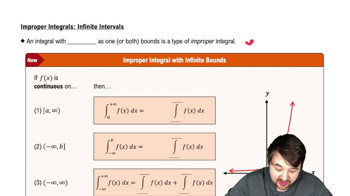
When the region extends infinitely, such as from a finite point to infinity, the integral is called an improper integral. Evaluating it involves taking a limit as the upper bound approaches infinity to determine if the area converges to a finite value.
Recommended video:
Improper Integrals: Infinite Intervals
Exponential Decay Function y = e^(-x)
The function y = e^(-x) is an exponential decay curve that approaches zero as x approaches infinity. Its properties ensure that the area under the curve from zero to infinity converges, making it suitable for calculating finite areas over infinite intervals.
Recommended video:
Integrals of Natural Exponential Functions (e^x)
Related Practice
Textbook Question
60
views
Textbook Question
Evaluate the integrals in Exercises 1–24 using integration by parts.
∫ θ cos(πθ) dθ
12
views
Textbook Question
Volume: Find the volume of the solid generated by revolving the region in Exercise 45 about the x-axis.
58
views
Textbook Question
The integrals in Exercises 1–44 are in no particular order. Evaluate each integral using any algebraic method, trigonometric identity, or substitution you think is appropriate.
∫ (dx / ((2x + 1)√(4x + 4x²)))
30
views
Textbook Question
The integrals in Exercises 1–44 are in no particular order. Evaluate each integral using any algebraic method, trigonometric identity, or substitution you think is appropriate.
∫ (2^(√y) dy) / 2√y
30
views
Textbook Question
Expand the quotients in Exercises 1–8 by partial fractions.
z / (z³ - z² - 6z)
21
views