Explain why or why not Determine whether the following statements are true and give an explanation or counterexample. d. The direction field for the differential equation y′(t)=t+y(t) is plotted in the ty-plane.
Verified step by step guidance
1
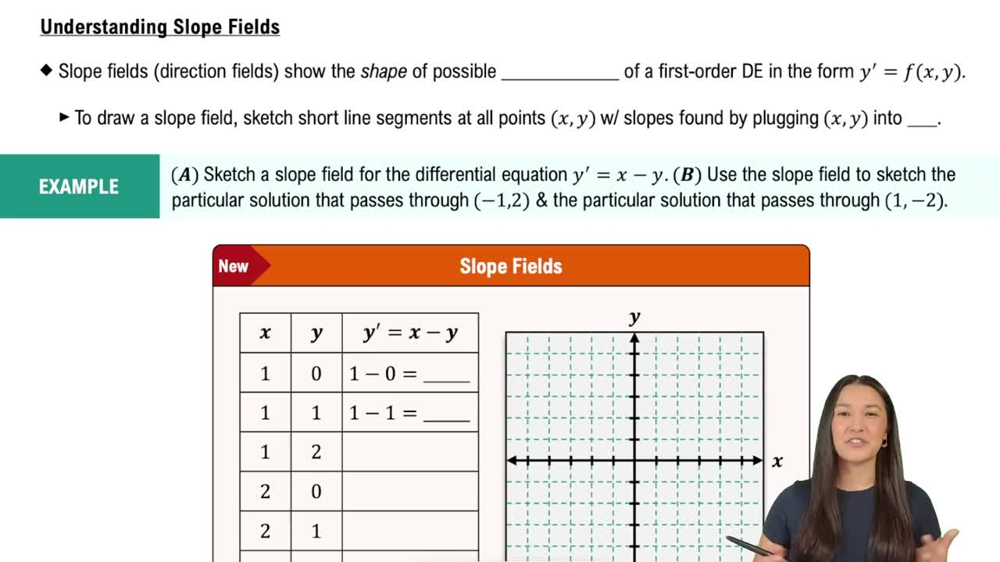
Recall that a direction field (or slope field) for a differential equation of the form \(y'(t) = f(t, y)\) is a graphical representation that shows the slope of the solution curve at each point \((t, y)\) in the \(ty\)-plane.
In this problem, the differential equation is \(y'(t) = t + y(t)\), where the slope at any point depends on both the independent variable \(t\) and the dependent variable \(y\).
Since the slope depends on both \(t\) and \(y\), the direction field must be plotted in the \(ty\)-plane, where the horizontal axis represents \(t\) and the vertical axis represents \(y\).
At each point \((t, y)\) in this plane, a small line segment is drawn with slope equal to \(t + y\), visually indicating the direction of the solution curve passing through that point.
Therefore, the statement is true because the direction field for \(y'(t) = t + y(t)\) is indeed plotted in the \(ty\)-plane.
Verified video answer for a similar problem:
This video solution was recommended by our tutors as helpful for the problem above
Video duration:
2m
Play a video:
0 Comments
Key Concepts
Here are the essential concepts you must grasp in order to answer the question correctly.
Direction Fields for Differential Equations
A direction field (or slope field) is a graphical representation of a first-order differential equation, showing small line segments with slopes given by the equation at various points. It helps visualize the behavior of solutions without solving the equation explicitly.
Independent and Dependent Variables in Differential Equations
In a differential equation y'(t) = f(t, y), t is the independent variable (often representing time), and y(t) is the dependent variable. The direction field is typically plotted in the plane with axes representing these variables, usually the t-y plane.
The notation 'ty-plane' can be ambiguous; the standard convention is to plot the direction field in the t-y plane, where the horizontal axis is t and the vertical axis is y. Understanding this helps determine if the statement about plotting in the 'ty-plane' is correct or not.

 2:51 minutes
 Verified step by step guidance
 05:45
05:45