
What are the two general ways in which an improper integral may occur?
Table of contents
- 0. Functions7h 54m
- Introduction to Functions16m
- Piecewise Functions10m
- Properties of Functions9m
- Common Functions1h 8m
- Transformations5m
- Combining Functions27m
- Exponent rules32m
- Exponential Functions28m
- Logarithmic Functions24m
- Properties of Logarithms36m
- Exponential & Logarithmic Equations35m
- Introduction to Trigonometric Functions38m
- Graphs of Trigonometric Functions44m
- Trigonometric Identities47m
- Inverse Trigonometric Functions48m
- 1. Limits and Continuity2h 2m
- 2. Intro to Derivatives1h 33m
- 3. Techniques of Differentiation3h 18m
- 4. Applications of Derivatives2h 38m
- 5. Graphical Applications of Derivatives6h 2m
- 6. Derivatives of Inverse, Exponential, & Logarithmic Functions2h 37m
- 7. Antiderivatives & Indefinite Integrals1h 26m
- 8. Definite Integrals4h 44m
- 9. Graphical Applications of Integrals2h 27m
- 10. Physics Applications of Integrals 3h 16m
- 11. Integrals of Inverse, Exponential, & Logarithmic Functions2h 34m
- 12. Techniques of Integration7h 41m
- 13. Intro to Differential Equations2h 55m
- 14. Sequences & Series5h 36m
- 15. Power Series2h 19m
- 16. Parametric Equations & Polar Coordinates7h 58m
12. Techniques of Integration
Improper Integrals
Problem 8.9.101d
Textbook Question
101. Many methods needed Show that the integral from ∫(from 0 to ∞)(sqrt(x) * ln x) / (1 + x)^2 dx equals pi, following these steps
d. Evaluate the remaining integral using the change of variables z = sqrt(x)
Verified step by step guidance1
Start with the integral after previous simplifications, which should be of the form \(\int_0^{\infty} \frac{\sqrt{x} \ln x}{(1+x)^2} \, dx\).
Apply the substitution \(z = \sqrt{x}\), which implies \(x = z^2\). Then, compute the differential \(dx\) in terms of \(dz\): \(dx = 2z \, dz\).
Rewrite the integral in terms of \(z\) by substituting \(x = z^2\), \(\sqrt{x} = z\), \(\ln x = \ln(z^2) = 2 \ln z\), and \(dx = 2z \, dz\). The integral becomes \(\int_0^{\infty} \frac{z \cdot 2 \ln z}{(1 + z^2)^2} \cdot 2z \, dz\).
Simplify the integrand by combining terms: \(z \cdot 2 \ln z \cdot 2z = 4 z^2 \ln z\), so the integral is \(\int_0^{\infty} \frac{4 z^2 \ln z}{(1 + z^2)^2} \, dz\).
Now, the integral is expressed in terms of \(z\) and can be evaluated using appropriate methods such as integration by parts or recognizing it as a standard integral form.
Verified video answer for a similar problem:This video solution was recommended by our tutors as helpful for the problem above
Video duration:
4mPlay a video:
Was this helpful?
Key Concepts
Here are the essential concepts you must grasp in order to answer the question correctly.
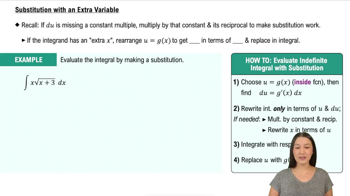
Change of Variables (Substitution) in Integration
This technique involves replacing the original variable with a new variable to simplify the integral. By setting z = sqrt(x), we rewrite the integral in terms of z, which often makes the integral easier to evaluate. It requires adjusting the differential dx accordingly and changing the limits of integration.
Recommended video:
Substitution With an Extra Variable
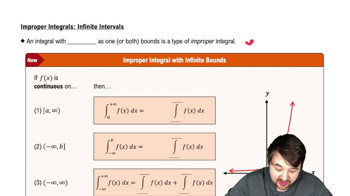
Improper Integrals over Infinite Intervals
Integrals with limits extending to infinity are called improper integrals. Evaluating them requires understanding limits and convergence. Here, the integral from 0 to ∞ must be handled carefully, ensuring the integral converges and applying appropriate techniques to evaluate it.
Recommended video:
Improper Integrals: Infinite Intervals
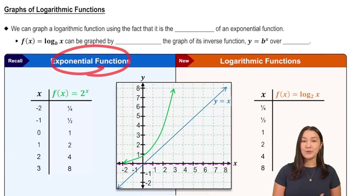
Logarithmic Functions within Integrals
Integrals involving logarithmic terms, such as ln(x), often require special attention due to their behavior near zero and infinity. Understanding properties of logarithms and how they interact with other functions in the integrand is essential for simplifying and evaluating the integral.
Recommended video:
Graphs of Logarithmic Functions
Watch next
Master Improper Integrals: Infinite Intervals with a bite sized video explanation from Patrick
Start learningRelated Videos
Related Practice
Textbook Question
8
views
