
Textbook Question
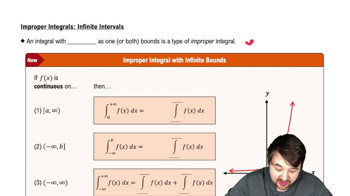
7–58. Improper integrals Evaluate the following integrals or state that they diverge.
53. ∫ (from 0 to 1) ln x dx
78
views

 Verified step by step guidance
 11:11
11:11
 10:07
10:07 05:50
05:507–58. Improper integrals Evaluate the following integrals or state that they diverge.
53. ∫ (from 0 to 1) ln x dx
65-76. Volumes Find the volume of the described solid of revolution or state that it does not exist.
66. The region bounded by f(x) = (x^2 + 1)^(-1/2) and the x-axis on the interval [2, ∞) is revolved about the x-axis.
59. Perpetual Annuity
Imagine that today you deposit \(B in a savings account that earns interest at a rate of *p*% per year compounded continuously (see Section 7.2). The goal is to draw an income of \)I per year from the account forever. The amount of money that must be deposited is:
B = I × ∫(from 0 to ∞) e^(-rt) dt
where r = p/100.
Suppose you find an account that earns 12% interest annually, and you wish to have an income from the account of \$5000 per year. How much must you deposit today?
7–64. Integration review Evaluate the following integrals.
47. ∫ dx / (x⁻¹ + 1)
71-74. Deriving formulas Evaluate the following integrals. Assume a and b are real numbers and n is a positive integer.
74. ∫xⁿ arcsin(x) dx (Hint: integration by parts.)
7–64. Integration review Evaluate the following integrals.
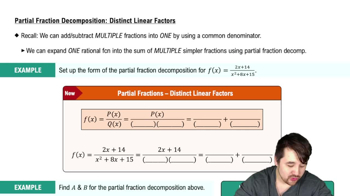
62. ∫ (-x⁵ - x⁴ - 2x³ + 4x + 3) / (x² + x + 1) dx