102–106. Laplace transforms A powerful tool in solving problems in engineering and physics is the Laplace transform. Given a function f(t), the Laplace transform is a new function F(s) defined by F(s) = ∫[0 to ∞] e^(-st) f(t) dt, where we assume s is a positive real number. For example, to find the Laplace transform of f(t) = e^(-t), the following improper integral is evaluated using integration by parts: F(s) = ∫[0 to ∞] e^(-st) e^(-t) dt = ∫[0 to ∞] e^(-(s+1)t) dt = 1/(s+1). Verify the following Laplace transforms, where a is a real number. 104. f(t) = t → F(s) = 1/s²
Verified step by step guidance
1
Start with the definition of the Laplace transform for the function \(f(t) = t\):
\[F(s) = \int_0^{\infty} e^{-st} t \, dt\]
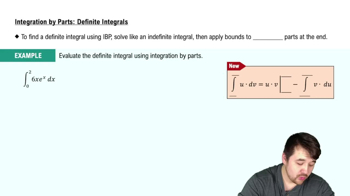
Recognize that this integral involves the product of \(t\) and an exponential function, which suggests using integration by parts. Recall the integration by parts formula:
\[\int u \, dv = uv - \int v \, du\]
Choose \(u = t\) so that \(du = dt\), and choose \(dv = e^{-st} dt\) so that \(v = \int e^{-st} dt = -\frac{1}{s} e^{-st}\). Substitute these into the integration by parts formula:
Apply the limits of integration from 0 to \(\infty\) to the term \(uv = t \cdot \left(-\frac{1}{s} e^{-st}\right)\) and evaluate the remaining integral \(\int_0^{\infty} \frac{1}{s} e^{-st} dt\).
Simplify the expression carefully, noting that the exponential term \(e^{-st}\) tends to zero as \(t \to \infty\) for \(s > 0\), and evaluate the definite integrals to express \(F(s)\) in terms of \(s\). This will lead to the result \(F(s) = \frac{1}{s^2}\).
Verified video answer for a similar problem:
This video solution was recommended by our tutors as helpful for the problem above
Video duration:
3m
Play a video:
0 Comments
Key Concepts
Here are the essential concepts you must grasp in order to answer the question correctly.
Definition of the Laplace Transform
The Laplace transform converts a time-domain function f(t) into a complex frequency-domain function F(s) using the integral F(s) = ∫₀^∞ e^(-st) f(t) dt. This transformation simplifies solving differential equations by turning them into algebraic equations in terms of s.
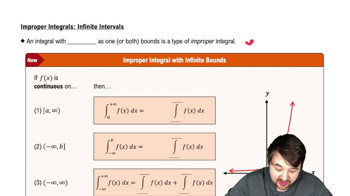
The Laplace transform integral is improper because it extends to infinity. Understanding when the integral converges (typically for s > 0) is essential to ensure the transform exists. Techniques like evaluating limits and recognizing exponential decay help determine convergence.
Integration by parts is a method used to evaluate integrals involving products of functions, such as t·e^(-st). It is based on the formula ∫u dv = uv - ∫v du and is crucial for finding Laplace transforms of functions like f(t) = t, where direct integration is not straightforward.