2–74. Integration techniques Use the methods introduced in Sections 8.1 through 8.5 to evaluate the following integrals. 43. ∫ eˣ sin(x) dx
Verified step by step guidance
1
Recognize that the integral \( \int e^{x} \sin(x) \, dx \) involves a product of an exponential function and a trigonometric function, which suggests using integration by parts or a special technique for such integrals.
Set up integration by parts by choosing \( u = \sin(x) \) and \( dv = e^{x} dx \). Then compute \( du = \cos(x) dx \) and \( v = e^{x} \).
Apply the integration by parts formula: \( \int u \, dv = uv - \int v \, du \), which gives \( \int e^{x} \sin(x) dx = e^{x} \sin(x) - \int e^{x} \cos(x) dx \).
Notice that the new integral \( \int e^{x} \cos(x) dx \) is similar in form to the original integral. Apply integration by parts again to this integral, choosing \( u = \cos(x) \) and \( dv = e^{x} dx \), then find \( du = -\sin(x) dx \) and \( v = e^{x} \).
After applying integration by parts the second time, you will get an expression involving the original integral \( \int e^{x} \sin(x) dx \). Collect like terms and solve algebraically for the original integral to express it in terms of elementary functions plus the constant of integration.
Verified video answer for a similar problem:
This video solution was recommended by our tutors as helpful for the problem above
Video duration:
6m
Play a video:
0 Comments
Key Concepts
Here are the essential concepts you must grasp in order to answer the question correctly.
Integration by Parts
Integration by parts is a technique based on the product rule for differentiation. It transforms the integral of a product of functions into simpler integrals, using the formula ∫u dv = uv - ∫v du. This method is especially useful when integrating products like eˣ sin(x).
Exponential functions like eˣ have the unique property that their derivative and integral are proportional to themselves. Recognizing this helps simplify integrals involving eˣ, as integrating eˣ results in eˣ plus a constant, which is crucial when combined with other functions.
Trigonometric functions such as sin(x) and cos(x) have well-known integrals and derivatives. Understanding these allows for effective use of integration techniques, especially when combined with other functions, as in the integral of eˣ sin(x), where repeated integration by parts leads to a solvable equation.

 6:07 minutes
 Verified step by step guidance
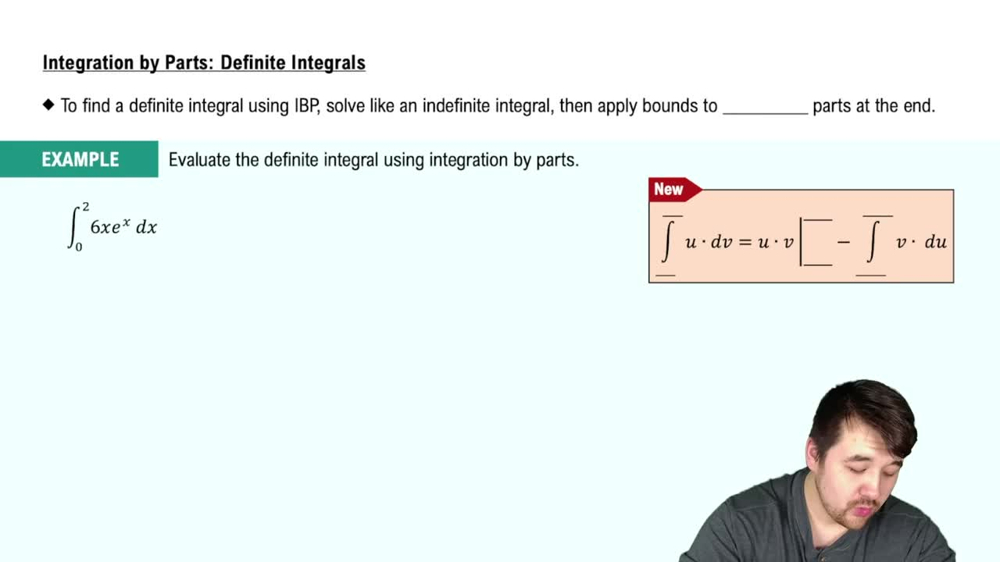
 06:18
06:18