
Surface area of a catenoid When the catenary y = a cosh x/a is revolved about the x-axis, it sweeps out a surface of revolution called a catenoid. Find the area of the surface generated when y = cosh x on [–ln 2, ln 2] is rotated about the x-axis.
Table of contents
- 0. Functions7h 54m
- Introduction to Functions16m
- Piecewise Functions10m
- Properties of Functions9m
- Common Functions1h 8m
- Transformations5m
- Combining Functions27m
- Exponent rules32m
- Exponential Functions28m
- Logarithmic Functions24m
- Properties of Logarithms36m
- Exponential & Logarithmic Equations35m
- Introduction to Trigonometric Functions38m
- Graphs of Trigonometric Functions44m
- Trigonometric Identities47m
- Inverse Trigonometric Functions48m
- 1. Limits and Continuity2h 2m
- 2. Intro to Derivatives1h 33m
- 3. Techniques of Differentiation3h 18m
- 4. Applications of Derivatives2h 38m
- 5. Graphical Applications of Derivatives6h 2m
- 6. Derivatives of Inverse, Exponential, & Logarithmic Functions2h 37m
- 7. Antiderivatives & Indefinite Integrals1h 26m
- 8. Definite Integrals4h 44m
- 9. Graphical Applications of Integrals2h 27m
- 10. Physics Applications of Integrals 3h 16m
- 11. Integrals of Inverse, Exponential, & Logarithmic Functions2h 34m
- 12. Techniques of Integration7h 41m
- 13. Intro to Differential Equations2h 55m
- 14. Sequences & Series5h 36m
- 15. Power Series2h 19m
- 16. Parametric Equations & Polar Coordinates7h 58m
9. Graphical Applications of Integrals
Introduction to Volume & Disk Method
Problem 6.4.63a
Textbook Question
Explain why or why not Determine whether the following statements are true and give an explanation or counterexample.
a. When using the shell method, the axis of the cylindrical shells is parallel to the axis of revolution.
Verified step by step guidance1
Recall the shell method is used to find volumes of solids of revolution by integrating cylindrical shells formed by revolving a region around an axis.
Understand that in the shell method, each shell is generated by revolving a vertical or horizontal strip around the axis of revolution.
Note that the axis of each cylindrical shell is actually perpendicular to the axis of revolution, because the shell is formed by rotating a line segment around that axis.
Therefore, the statement 'the axis of the cylindrical shells is parallel to the axis of revolution' is false.
A counterexample: If the axis of revolution is the x-axis, the shells are vertical cylinders whose axes are parallel to the y-axis, which is perpendicular to the x-axis.
Verified video answer for a similar problem:This video solution was recommended by our tutors as helpful for the problem above
Video duration:
2mPlay a video:
Was this helpful?
Key Concepts
Here are the essential concepts you must grasp in order to answer the question correctly.
Shell Method for Volume Calculation
The shell method is a technique for finding the volume of a solid of revolution by integrating cylindrical shells. It involves slicing the solid into thin shells parallel to the axis of revolution and summing their volumes. Understanding how these shells are formed and their dimensions is crucial to applying the method correctly.
Recommended video:
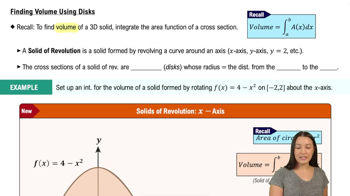
Finding Volume Using Disks
Axis of Revolution
The axis of revolution is the line about which a region is rotated to generate a solid. It serves as a reference for determining the shape and orientation of the solid and the shells or disks used in volume calculations. Recognizing the axis helps in setting up the integral and choosing the appropriate method.
Recommended video:
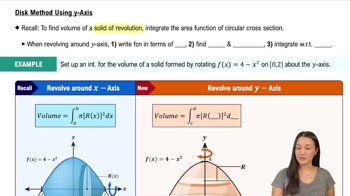
Disk Method Using y-Axis
Orientation of Cylindrical Shells Relative to the Axis
In the shell method, cylindrical shells are formed by revolving vertical or horizontal slices around the axis of revolution. Importantly, the axis of each shell is perpendicular, not parallel, to the axis of revolution. This orientation affects how the radius and height of each shell are defined in the integral.
Recommended video:
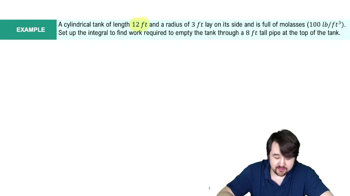
Pumping Liquids Example 5
Watch next
Master Introduction to Cross Sections with a bite sized video explanation from Patrick
Start learningRelated Videos
Related Practice
Textbook Question
19
views
