How do you obtain the graph of y=f(3x)from the graph of y=f(x)?
Verified step by step guidance
1
Start by understanding the transformation involved. The function y = f(3x) represents a horizontal compression of the graph of y = f(x).
Recall that multiplying the input of a function by a constant greater than 1 compresses the graph horizontally. In this case, the factor is 3.
To visualize this, consider any point (a, b) on the graph of y = f(x). For the graph of y = f(3x), this point will be transformed to (a/3, b).
This means that every x-coordinate on the graph of y = f(x) is divided by 3 to obtain the corresponding x-coordinate on the graph of y = f(3x).
Finally, sketch the new graph by applying this transformation to key points and features of the original graph, such as intercepts and turning points, to see the compressed version.
Verified video answer for a similar problem:
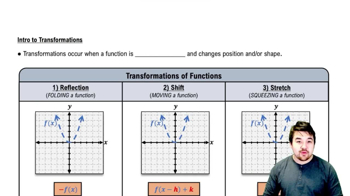
This video solution was recommended by our tutors as helpful for the problem above
Video duration:
8m
Play a video:
Was this helpful?
Key Concepts
Here are the essential concepts you must grasp in order to answer the question correctly.
Function Transformation
Function transformation refers to the process of altering the graph of a function through various operations, such as shifting, stretching, or compressing. In this case, the transformation involves replacing the input variable 'x' with '3x', which compresses the graph horizontally by a factor of 3. Understanding how these transformations affect the graph is crucial for accurately sketching the new function.
Horizontal compression occurs when the input of a function is multiplied by a factor greater than 1, resulting in the graph being 'squeezed' towards the y-axis. For the function y = f(3x), the factor of 3 compresses the graph horizontally, meaning that points on the original graph will be closer together on the new graph. This concept is essential for predicting how the shape of the graph changes.
Graphing techniques involve methods used to accurately represent functions visually. This includes understanding the original function's key features, such as intercepts and asymptotes, and applying transformations systematically. By mastering these techniques, one can effectively sketch the transformed graph of y = f(3x) based on the original graph of y = f(x).