
Ch. 6 - Applications of Integration
Briggs - Calculus: Early Transcendentals 3rd Edition
Briggs3rd EditionCalculus: Early TranscendentalsISBN: 9780136847243Not the one you use?Change textbook
Chapter 6, Problem 6.7.29a

Calculating work for different springs Calculate the work required to stretch the following springs 1.25 m from their equilibrium positions. Assume Hooke’s law is obeyed.
a. A spring that requires 100 J of work to be stretched 0.5 m from its equilibrium position

Verified step by step guidance
1
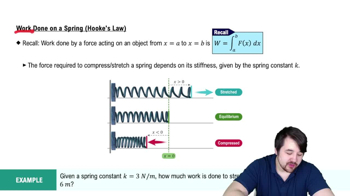
Recall that the work done to stretch or compress a spring from its equilibrium position is given by the formula \(W = \frac{1}{2} k x^2\), where \(k\) is the spring constant and \(x\) is the displacement from equilibrium.
Use the information given for the first spring: it requires 100 J of work to stretch it 0.5 m. Substitute \(W = 100\) J and \(x = 0.5\) m into the formula to find the spring constant \(k\) by solving \(100 = \frac{1}{2} k (0.5)^2\).
Rearrange the equation to solve for \(k\): multiply both sides by 2 and divide by \((0.5)^2\) to isolate \(k\).
Once you have the value of \(k\), use it to calculate the work required to stretch the spring 1.25 m by substituting \(x = 1.25\) m into the work formula \(W = \frac{1}{2} k x^2\).
Evaluate the expression to find the work done for the 1.25 m stretch, which will give you the required answer.

Verified video answer for a similar problem:

This video solution was recommended by our tutors as helpful for the problem above.
Video duration:
4m
Was this helpful?

Key Concepts

Here are the essential concepts you must grasp in order to answer the question correctly.

Hooke's Law

Hooke's Law states that the force required to stretch or compress a spring is proportional to the displacement from its equilibrium position, expressed as F = kx, where k is the spring constant and x is the displacement. This linear relationship is fundamental for calculating forces and work in spring problems.
Recommended video:
05:40
Work Done On A Spring (Hooke's Law)

Work Done by a Variable Force

When stretching a spring, the force varies with displacement, so work is calculated as the integral of force over distance: W = ∫ F dx. For springs, this results in W = (1/2) k x², representing the energy stored in the spring when stretched or compressed.
Recommended video:
05:40
Work Done On A Spring (Hooke's Law)

Determining the Spring Constant from Work

Given the work done to stretch a spring a certain distance, the spring constant k can be found by rearranging the work formula: k = 2W / x². Knowing k allows calculation of work for other displacements, enabling solutions to problems involving different stretch lengths.
Recommended video:
05:40
Work Done On A Spring (Hooke's Law)
Related Practice
Textbook Question

Displacement and distance from velocity Consider the graph shown in the figure, which gives the velocity of an object moving along a line. Assume time is measured in hours and distance is measured in miles. The areas of three regions bounded by the velocity curve and the t-axis are also given.

a. On what intervals is the object moving in the positive direction?

49
views
Textbook Question

Determine whether the following statements are true and give an explanation or counterexample. 


a. If the curve y=f(x) on the interval [a, b] is revolved about the y-axis, the area of the surface generated is ∫f(b)f(a) 2πf(y)√1+f′(y)^2 dy.

64
views
Textbook Question

Explain why or why not Determine whether the following statements are true and give an explanation or counterexample.

a. When using the shell method, the axis of the cylindrical shells is parallel to the axis of revolution.

53
views
Textbook Question

Bike race Theo and Sasha start at the same place on a straight road, riding bikes with the following velocities (measured in mi/hr). Assume t is measured in hours.

Theo: vT(t)=10, for t≥0

Sasha: vS(t)=15t, for 0≤t≤1, and vS(t)=15, for t>1


a. Graph the velocity function for both riders. 

28
views
Textbook Question

21–30. {Use of Tech} Arc length by calculator


a. Write and simplify the integral that gives the arc length of the following curves on the given interval. 

y = ln x, for 1≤x≤4

39
views
Textbook Question

For the given regions R₁ and R₂, complete the following steps.


a. Find the area of region R₁.


R₁is the region in the first quadrant bounded by the line x=1 and the curve y=6x(2−x^2)^2; R₂ is the region in the first quadrant bounded the curve y=6x(2−x^2)^2and the line y=6x.

34
views