Composite functions and notation Let ƒ(x)= x² - 4, g(x) = x³ and F(x) = 1/(x-3). Simplify or evaluate the following expressions. ƒ (√(x+4))
Verified step by step guidance
1
Identify the function \( f(x) = x^2 - 4 \).
Recognize that you need to evaluate \( f(\sqrt{x+4}) \).
Substitute \( \sqrt{x+4} \) into the function \( f(x) \), replacing \( x \) with \( \sqrt{x+4} \).
The expression becomes \( (\sqrt{x+4})^2 - 4 \).
Simplify the expression by calculating \( (\sqrt{x+4})^2 \) which results in \( x+4 \), and then subtract 4.
Verified video answer for a similar problem:
This video solution was recommended by our tutors as helpful for the problem above
Video duration:
1m
Play a video:
0 Comments
Key Concepts
Here are the essential concepts you must grasp in order to answer the question correctly.
Composite Functions
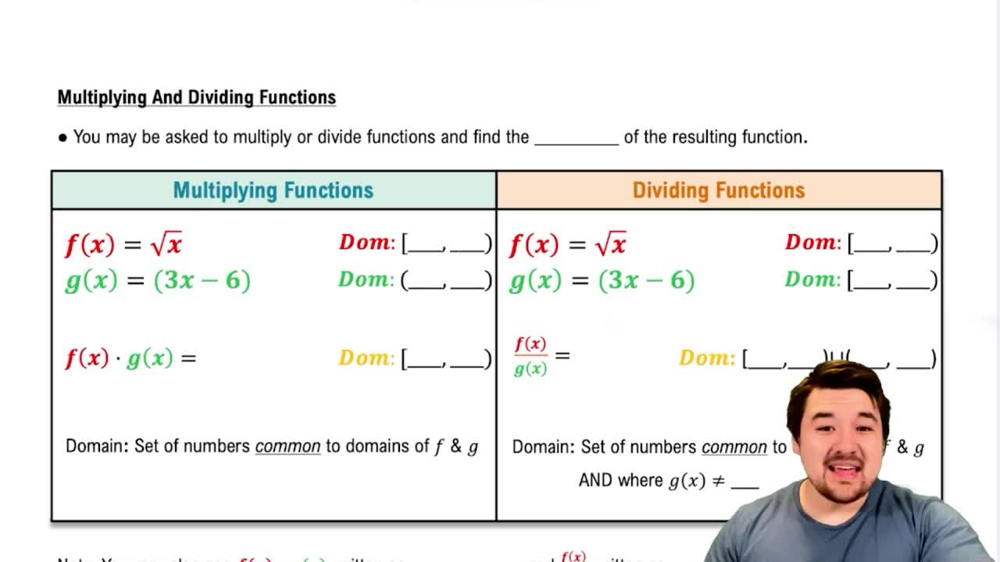
A composite function is formed when one function is applied to the result of another function. In this case, if we have functions f and g, the composite function f(g(x)) means we first evaluate g at x and then apply f to that result. Understanding how to manipulate and simplify composite functions is crucial for evaluating expressions like f(√(x+4)).
Function notation is a way to denote functions and their operations clearly. For example, f(x) represents the function f evaluated at x. This notation allows us to express complex operations succinctly, such as f(√(x+4)), which indicates that we need to substitute √(x+4) into the function f. Mastery of function notation is essential for working with multiple functions.
Simplification involves reducing an expression to its simplest form, making it easier to work with or evaluate. This can include combining like terms, factoring, or substituting values. In the context of the given problem, simplifying f(√(x+4)) requires substituting √(x+4) into the function f and then performing algebraic operations to arrive at a more manageable expression.