In Exercises 19–26, use implicit differentiation to find dy/dx and then d²y/dx². Write the solutions in terms of x and y only.
y² = x² + 2x
Verified step by step guidance
1
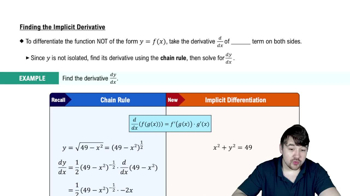
Start by differentiating both sides of the equation y² = x² + 2x with respect to x. Remember that y is a function of x, so you'll need to use implicit differentiation for the left side. The derivative of y² with respect to x is 2y(dy/dx), and the derivative of x² + 2x is 2x + 2.
Set the derivatives equal to each other: 2y(dy/dx) = 2x + 2. Solve for dy/dx by dividing both sides by 2y, giving dy/dx = (2x + 2)/(2y).
Now, to find the second derivative d²y/dx², differentiate dy/dx = (2x + 2)/(2y) with respect to x again. Use the quotient rule, which states that if you have a function u/v, its derivative is (u'v - uv')/v².
Apply the quotient rule: Let u = 2x + 2 and v = 2y. Then u' = 2 and v' = 2(dy/dx). Substitute these into the quotient rule formula: d²y/dx² = [(2)(2y) - (2x + 2)(2(dy/dx))]/(2y)².
Simplify the expression for d²y/dx². Substitute dy/dx from step 2 into the expression where needed, and simplify the algebraic expression to write the second derivative in terms of x and y only.
Verified video answer for a similar problem:
This video solution was recommended by our tutors as helpful for the problem above
Video duration:
5m
Play a video:
0 Comments
Key Concepts
Here are the essential concepts you must grasp in order to answer the question correctly.
Implicit Differentiation
Implicit differentiation is a technique used to differentiate equations where y is not isolated on one side. Instead of solving for y explicitly, we differentiate both sides of the equation with respect to x, applying the chain rule when differentiating y. This allows us to find dy/dx in terms of x and y, which is essential for problems involving relationships between variables that are not easily separable.
The first derivative, denoted as dy/dx, represents the rate of change of the function y with respect to x. It provides information about the slope of the tangent line to the curve at any given point. In the context of implicit differentiation, finding dy/dx allows us to understand how y changes as x changes, which is crucial for further analysis, such as finding the second derivative.
The second derivative, denoted as d²y/dx², measures the rate of change of the first derivative. It provides insights into the curvature of the function, indicating whether the function is concave up or concave down at a point. In the context of implicit differentiation, calculating the second derivative involves differentiating dy/dx again, which often requires applying the product and chain rules, and it is essential for understanding the behavior of the function beyond just its slope.