Sigma notation Evaluate the following expressions. (e) 3 ∑ (2m + 2) / 3 m =1
Verified step by step guidance
1
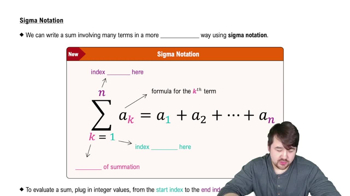
Step 1: Understand the problem. The given expression is a summation in sigma notation: ∑ (2m + 2) / 3, where m starts at 1 and goes up to a specified upper limit. Sigma notation represents the sum of terms generated by substituting values of m into the given formula.
Step 2: Identify the range of summation. The problem does not explicitly state the upper limit of m, so ensure you know the range of m values to evaluate the summation. For example, if the upper limit is n, the summation would be ∑ from m=1 to m=n.
Step 3: Break down the summation formula. The term (2m + 2) / 3 can be split into two separate terms: (2m / 3) + (2 / 3). This allows you to compute the summation of each part separately.
Step 4: Apply the summation rules. Use the linearity of summation: ∑ [(2m / 3) + (2 / 3)] = (2/3) ∑ m + (2/3) ∑ 1. Here, ∑ m represents the sum of integers from 1 to n, and ∑ 1 represents the sum of n ones.
Step 5: Compute the individual summations. For ∑ m, use the formula for the sum of the first n integers: ∑ m = n(n + 1) / 2. For ∑ 1, the result is simply n. Substitute these results back into the expression to simplify further.
Verified video answer for a similar problem:
This video solution was recommended by our tutors as helpful for the problem above
Video duration:
3m
Play a video:
Was this helpful?
Key Concepts
Here are the essential concepts you must grasp in order to answer the question correctly.
Sigma Notation
Sigma notation is a concise way to represent the sum of a sequence of terms. It uses the Greek letter sigma (Σ) to indicate summation, followed by an expression that defines the terms to be summed. The notation includes limits that specify the starting and ending indices of the summation, allowing for efficient representation of large sums.
Arithmetic expressions are mathematical phrases that combine numbers, variables, and operators (such as addition, subtraction, multiplication, and division) to represent a value. In the context of sigma notation, the expression inside the summation often involves variables and constants, which can be manipulated to simplify or evaluate the sum.
Evaluating summations involves calculating the total value of a series of terms defined by a summation expression. This process may require substituting values for the variable, performing arithmetic operations, and applying algebraic techniques to simplify the expression before arriving at the final sum. Understanding how to manipulate and compute these expressions is crucial for solving problems involving sigma notation.