
Ch. 9 - Differential Equations
Briggs - Calculus: Early Transcendentals 3rd Edition
Briggs3rd EditionCalculus: Early TranscendentalsISBN: 9780136847243Not the one you use?Change textbook
Chapter 9, Problem 9.2.49b

Convergence of Euler's method Suppose Euler's method is applied to the initial value problem y′(t) = ay, y(0) = 1, which has the exact solution y(t) = eᵃᵗ. For this exercise, let h denote the time step (rather than Δt). The grid points are then given by tₖ = kh. We let uₖ be the Euler approximation to the exact solution y(tₖ), for k = 0, 1, 2, ...
b. Show by substitution that uₖ = (1 + ah)ᵏ is a solution of the equations in part (a), for k = 0, 1, 2, ...

Verified step by step guidance
1
Recall the Euler's method update formula for the initial value problem \(y'(t) = ay\) with step size \(h\): \[u_{k+1} = u_k + h f(t_k, u_k)\] Since \(f(t, y) = ay\), this becomes: \[u_{k+1} = u_k + h a u_k = u_k (1 + a h)\]
Given the initial condition \(u_0 = y(0) = 1\), we want to verify that the proposed solution \[u_k = (1 + a h)^k\] satisfies the Euler update formula for all \(k = 0, 1, 2, \ldots\)
Substitute \(u_k = (1 + a h)^k\) into the right-hand side of the Euler update formula: \[u_k (1 + a h) = (1 + a h)^k (1 + a h) = (1 + a h)^{k+1}\]
Compare this with the left-hand side \(u_{k+1}\), which according to the proposed solution is: \[u_{k+1} = (1 + a h)^{k+1}\]
Since both sides are equal, this confirms by substitution that \(u_k = (1 + a h)^k\) satisfies the Euler method recurrence relation for all \(k\).

Verified video answer for a similar problem:

This video solution was recommended by our tutors as helpful for the problem above.
Video duration:
5m
Was this helpful?

Key Concepts

Here are the essential concepts you must grasp in order to answer the question correctly.

Euler's Method

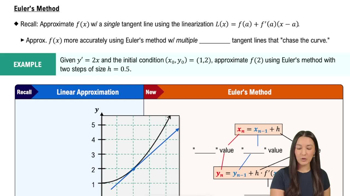
Euler's method is a numerical technique for approximating solutions to initial value problems of differential equations. It uses a stepwise approach, updating the solution by moving along the slope given by the differential equation at each grid point. The formula is u_{k+1} = u_k + h f(t_k, u_k), where h is the step size.
Recommended video:
07:33
Euler's Method

Initial Value Problem (IVP) and Exact Solution

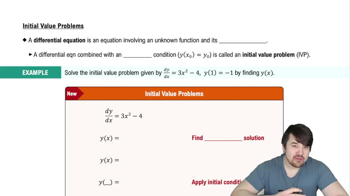
An initial value problem specifies a differential equation along with a starting value, such as y'(t) = ay with y(0) = 1. The exact solution to this IVP is y(t) = e^{at}, which provides a benchmark to compare numerical approximations like Euler's method.
Recommended video:
05:03
Initial Value Problems

Substitution to Verify Solutions

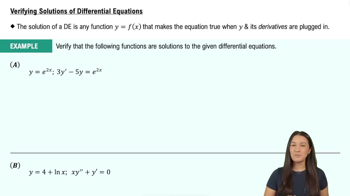
Substitution involves plugging a proposed solution into the given equation to verify its validity. Here, substituting u_k = (1 + ah)^k into the Euler update formula confirms it satisfies the recurrence relation, demonstrating that this expression correctly represents the numerical solution at each step.
Recommended video:
05:09
Verifying Solutions of Differential Equations
Related Practice
Textbook Question

38–43. Equilibrium solutions A differential equation of the form y′(t)=f(y) is said to be autonomous (the function f depends only on y). The constant function y=y0 is an equilibrium solution of the equation provided f(y0)=0 (because then y'(t)=0 and the solution remains constant for all t). Note that equilibrium solutions correspond to horizontal lines in the direction field. Note also that for autonomous equations, the direction field is independent of t. Carry out the following analysis on the given equations.

a. Find the equilibrium solutions. 


y′(t) = y(y - 3)(y + 2)

78
views
Textbook Question

Direction field analysis Consider the first-order initial value problem y'(t)=ay+b,y(0)=A for t≥0 where a, b, and A are real numbers.

a. Explain why y=−b/a is an equilibrium solution and corresponds to a horizontal line in the direction field.

57
views
Textbook Question

52-56. In this section, several models are presented and the solution of the associated differential equation is given. Later in the chapter, we present methods for solving these differential equations.


{Use of Tech} Drug infusion The delivery of a drug (such as an antibiotic) through an intravenous line may be modeled by the differential equation m'(t) + km(t) = I, where m(t) is the mass of the drug in the blood at time t ≥ 0, k is a constant that describes the rate at which the drug is absorbed, and I is the infusion rate.


b. Graph the solution for I = 10 mg/hr and k = 0.05 hr⁻¹.

36
views
Textbook Question

A bad loan Consider a loan repayment plan described by the initial value problem

B'(t)=0.03B−600,B(0)=40,000,

where the amount borrowed is B(0)=\$40,000, the monthly payments are \$600, and B(t) is the unpaid balance in the loan.

b. What is the most that you can borrow under the terms of this loan without going further into debt each month?

49
views
Textbook Question

{Use of Tech} Chemical rate equations Let y(t) be t he concentration of a substance in a chemical reaction (typical units are moles/liter). The change in the concentration, under appropriate conditions, is modeled by the equation dy/dt=-ky^n for t≥0, where k>0 is a rate constant and the positive integer n is the order of the reaction.

b. Solve the initial value problem for a second-order reaction (n=2) assuming y(0)=y0.

42
views
Textbook Question

29–32. {Use of Tech} Errors in Euler’s method Consider the following initial value problems.


b. Using the exact solution given, compute the errors in the Euler approximations at t=0.2 and t=0.4.


y′(t) = 2t + 1, y(0) = 0; y(t) = t² + t

67
views