
Ch. 9 - Differential Equations
Briggs - Calculus: Early Transcendentals 3rd Edition
Briggs3rd EditionCalculus: Early TranscendentalsISBN: 9780136847243Not the one you use?Change textbook
Chapter 9, Problem 9.2.50

Stability of Euler's method Consider the initial value problem y′(t) = −ay, y(0) = 1 where a > 0; it has the exact solution y(t) = e⁻ᵃᵗ, which is a decreasing function.


a. Show that Euler's method applied to this problem with time step h can be written u₀ = 1, uₖ₊₁ = (1 − ah)uₖ for k = 0, 1, 2, ...


b. Show by substitution that uₖ = (1 − ah)ᵏ is a solution of the equations in part (a), for k = 0, 1, 2, ...

Verified step by step guidance
1
Start with the given initial value problem: \(y'(t) = -ay\), with initial condition \(y(0) = 1\), where \(a > 0\).
Recall that Euler's method for approximating the solution to \(y' = f(t,y)\) with step size \(h\) is given by the iterative formula: \(u_{k+1} = u_k + h f(t_k, u_k)\), where \(u_0 = y(0)\).
Apply Euler's method to our specific problem where \(f(t,y) = -ay\). Substitute this into the formula to get: \(u_{k+1} = u_k + h(-a u_k) = u_k (1 - a h)\), with \(u_0 = 1\).
For part (b), to verify that \(u_k = (1 - a h)^k\) satisfies the recurrence relation, substitute \(u_k\) into the right-hand side of the Euler update: \(u_{k+1} = (1 - a h) u_k = (1 - a h) (1 - a h)^k = (1 - a h)^{k+1}\).
Check the base case: when \(k=0\), \(u_0 = (1 - a h)^0 = 1\), which matches the initial condition. Thus, by induction, \(u_k = (1 - a h)^k\) is the solution to the Euler method iteration.

Verified video answer for a similar problem:

This video solution was recommended by our tutors as helpful for the problem above.
Video duration:
4m
Was this helpful?

Key Concepts

Here are the essential concepts you must grasp in order to answer the question correctly.

Euler's Method for Solving ODEs

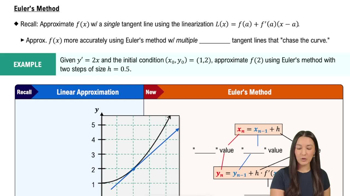
Euler's method is a numerical technique to approximate solutions of ordinary differential equations (ODEs). It uses a stepwise approach, updating the solution by moving forward in small increments (step size h) using the slope at the current point. For y' = f(t, y), the update formula is u_{k+1} = u_k + h f(t_k, u_k).
Recommended video:
07:33
Euler's Method

Difference Equations and Recurrence Relations

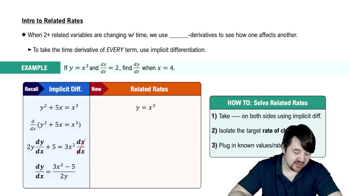
A difference equation expresses the relationship between successive terms in a sequence, often arising from discretizing differential equations. In this problem, the update u_{k+1} = (1 - ah) u_k forms a linear recurrence relation, which can be solved explicitly to find a closed-form expression for u_k.
Recommended video:
04:16
Intro To Related Rates

Stability and Behavior of Numerical Solutions

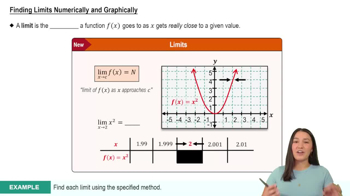
Stability in numerical methods refers to how errors propagate through iterations. For Euler's method applied to y' = -ay, the factor (1 - ah) determines if the numerical solution decays like the exact solution. Understanding when |1 - ah| < 1 ensures the method produces a decreasing sequence, mimicking the true solution's behavior.
Recommended video:
6:47
Finding Limits Numerically and Graphically