Use the given substitution to evaluate the following indefinite integrals. Check your answer by differentiating. β« 8π cos (4πΒ² + 3) dπ, u = 4πΒ² + 3
Verified step by step guidance
1
Step 1: Identify the substitution variable. The problem suggests using u = 4πΒ² + 3. This substitution simplifies the integral by replacing the complex expression inside the cosine function.
Step 2: Compute the derivative of u with respect to π to find du. Differentiating u = 4πΒ² + 3 gives du/dπ = 8π. Therefore, du = 8π dπ.
Step 3: Rewrite the integral in terms of u. Substitute u = 4πΒ² + 3 and du = 8π dπ into the integral. The integral becomes β« cos(u) du.
Step 4: Solve the simplified integral. The integral of cos(u) with respect to u is sin(u) + C, where C is the constant of integration.
Step 5: Substitute back the original variable. Replace u with 4πΒ² + 3 to express the solution in terms of π. The final result is sin(4πΒ² + 3) + C.
Verified video answer for a similar problem:
This video solution was recommended by our tutors as helpful for the problem above
Video duration:
1m
Play a video:
0 Comments
Key Concepts
Here are the essential concepts you must grasp in order to answer the question correctly.
Substitution Method
The substitution method is a technique used in integration to simplify the process by replacing a complex expression with a single variable. In this case, we let u = 4xΒ² + 3, which transforms the integral into a more manageable form. This method is particularly useful when dealing with integrals involving composite functions, as it allows for easier integration and ultimately leads to the solution.
Differentiation is the process of finding the derivative of a function, which measures how the function changes as its input changes. In the context of checking the result of an integral, differentiating the antiderivative obtained from the integration process should yield the original integrand. This step is crucial for verifying the correctness of the integration and ensuring that no mistakes were made during the substitution or integration steps.
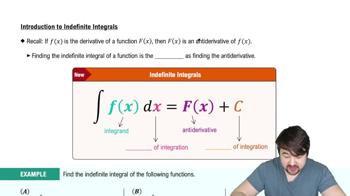
Indefinite integrals represent a family of functions whose derivative is the integrand. They are expressed with a constant of integration (C) because there are infinitely many antiderivatives differing by a constant. Understanding indefinite integrals is essential for solving problems in calculus, as they provide the foundational concept for finding areas under curves and solving differential equations.