Find the limits in Exercises 31–40. Are the functions continuous at the point being approached?
lim t → 0 sin (π/2 cos (tan t))
Verified step by step guidance
1
Identify the function for which you need to find the limit: \( \lim_{t \to 0} \sin \left( \frac{\pi}{2} \cos (\tan t) \right) \).
Evaluate the inner function \( \tan t \) as \( t \to 0 \). Since \( \tan t \approx t \) for small \( t \), \( \tan t \to 0 \) as \( t \to 0 \).
Substitute \( \tan t \to 0 \) into \( \cos (\tan t) \). Since \( \cos(0) = 1 \), \( \cos (\tan t) \to 1 \) as \( t \to 0 \).
Substitute \( \cos (\tan t) \to 1 \) into \( \frac{\pi}{2} \cos (\tan t) \). This simplifies to \( \frac{\pi}{2} \times 1 = \frac{\pi}{2} \).
Evaluate \( \sin \left( \frac{\pi}{2} \right) \). Since \( \sin \left( \frac{\pi}{2} \right) = 1 \), the limit is \( 1 \). The function is continuous at \( t = 0 \) because the limit exists and equals the function value at that point.
Verified video answer for a similar problem:
This video solution was recommended by our tutors as helpful for the problem above
Video duration:
4m
Play a video:
Was this helpful?
Key Concepts
Here are the essential concepts you must grasp in order to answer the question correctly.
Limits
Limits are fundamental in calculus, representing the value that a function approaches as the input approaches a certain point. In this case, we are evaluating the limit of the function as t approaches 0. Understanding limits helps in analyzing the behavior of functions near specific points, which is crucial for determining continuity and differentiability.
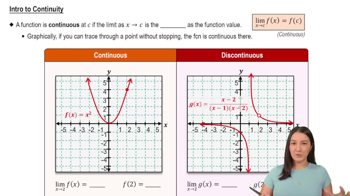
A function is continuous at a point if the limit of the function as it approaches that point equals the function's value at that point. For the given limit, we need to check if the function remains defined and behaves predictably as t approaches 0. Continuity is essential for ensuring that there are no abrupt changes in the function's value at the point of interest.
Trigonometric functions, such as sine and cosine, are periodic functions that relate angles to ratios of sides in right triangles. In the limit expression provided, the sine function is evaluated at an angle determined by the cosine of another function. Understanding the properties and behaviors of these functions is vital for accurately calculating limits involving trigonometric expressions.