
Filling a spherical tank A spherical water tank with an inner radius of 8 m has its lowest point 2 m above the ground. It is filled by a pipe that feeds the tank at its lowest point (see figure). Neglecting the volume of the inflow pipe, how much work is required to fill the tank if it is initially empty?
Table of contents
- 0. Functions7h 54m
- Introduction to Functions16m
- Piecewise Functions10m
- Properties of Functions9m
- Common Functions1h 8m
- Transformations5m
- Combining Functions27m
- Exponent rules32m
- Exponential Functions28m
- Logarithmic Functions24m
- Properties of Logarithms36m
- Exponential & Logarithmic Equations35m
- Introduction to Trigonometric Functions38m
- Graphs of Trigonometric Functions44m
- Trigonometric Identities47m
- Inverse Trigonometric Functions48m
- 1. Limits and Continuity2h 2m
- 2. Intro to Derivatives1h 33m
- 3. Techniques of Differentiation3h 18m
- 4. Applications of Derivatives2h 38m
- 5. Graphical Applications of Derivatives6h 2m
- 6. Derivatives of Inverse, Exponential, & Logarithmic Functions2h 37m
- 7. Antiderivatives & Indefinite Integrals1h 26m
- 8. Definite Integrals4h 44m
- 9. Graphical Applications of Integrals2h 27m
- 10. Physics Applications of Integrals 3h 16m
- 11. Integrals of Inverse, Exponential, & Logarithmic Functions2h 34m
- 12. Techniques of Integration7h 41m
- 13. Intro to Differential Equations2h 55m
- 14. Sequences & Series5h 36m
- 15. Power Series2h 19m
- 16. Parametric Equations & Polar Coordinates7h 58m
10. Physics Applications of Integrals
Work
Problem 6.7.46
Textbook Question
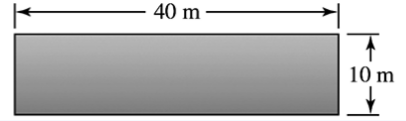
46–50. Force on dams The following figures show the shapes and dimensions of small dams. Assuming the water level is at the top of the dam, find the total force on the face of the dam.

Verified step by step guidance1
Identify the shape of the dam face, which is a rectangle with width 40 m and height 10 m, submerged in water up to the top.
Recall that the pressure exerted by a fluid at depth \(y\) is given by \(P(y) = \rho g y\), where \(\rho\) is the density of water, \(g\) is the acceleration due to gravity, and \(y\) is the depth measured from the surface.
Set up the coordinate system with \(y=0\) at the water surface and \(y\) increasing downward to 10 m at the bottom of the dam.
Express the force on a thin horizontal strip of the dam at depth \(y\) with thickness \(dy\) as \(dF = P(y) \times \text{area of strip} = \rho g y \times (40 \times dy)\).
Integrate this expression from \(y=0\) to \(y=10\) to find the total force: \(F = \int_0^{10} \rho g y \times 40 \, dy\).
Verified video answer for a similar problem:This video solution was recommended by our tutors as helpful for the problem above
Video duration:
2mPlay a video:
Was this helpful?
Key Concepts
Here are the essential concepts you must grasp in order to answer the question correctly.
Hydrostatic Pressure
Hydrostatic pressure is the pressure exerted by a fluid at rest due to the force of gravity. It increases linearly with depth and is given by the formula P = ρgh, where ρ is the fluid density, g is acceleration due to gravity, and h is the depth below the surface.
Force on a Surface Due to Fluid Pressure
The total force exerted by a fluid on a submerged surface is found by integrating the pressure over the area. Since pressure varies with depth, the force is the integral of pressure times the differential area, often simplified by using the average pressure at the centroid of the surface.
Recommended video:
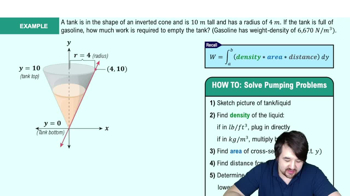
Pumping Liquids Example 2
Calculus Integration for Variable Pressure
Calculus integration is used to sum the infinitesimal forces over the dam face where pressure changes with depth. Setting up an integral with pressure as a function of depth and integrating over the height of the dam yields the total force.
Recommended video:
Fundamental Theorem of Calculus Part 1
Watch next
Master Introduction To Work with a bite sized video explanation from Patrick
Start learningRelated Videos
Related Practice
Textbook Question
8
views
