46–50. Force on dams The following figures show the shapes and dimensions of small dams. Assuming the water level is at the top of the dam, find the total force on the face of the dam.
Table of contents
- 0. Functions7h 54m
- Introduction to Functions16m
- Piecewise Functions10m
- Properties of Functions9m
- Common Functions1h 8m
- Transformations5m
- Combining Functions27m
- Exponent rules32m
- Exponential Functions28m
- Logarithmic Functions24m
- Properties of Logarithms36m
- Exponential & Logarithmic Equations35m
- Introduction to Trigonometric Functions38m
- Graphs of Trigonometric Functions44m
- Trigonometric Identities47m
- Inverse Trigonometric Functions48m
- 1. Limits and Continuity2h 2m
- 2. Intro to Derivatives1h 33m
- 3. Techniques of Differentiation3h 18m
- 4. Applications of Derivatives2h 38m
- 5. Graphical Applications of Derivatives6h 2m
- 6. Derivatives of Inverse, Exponential, & Logarithmic Functions2h 37m
- 7. Antiderivatives & Indefinite Integrals1h 26m
- 8. Definite Integrals4h 44m
- 9. Graphical Applications of Integrals2h 27m
- 10. Physics Applications of Integrals 3h 16m
- 11. Integrals of Inverse, Exponential, & Logarithmic Functions2h 34m
- 12. Techniques of Integration7h 41m
- 13. Intro to Differential Equations2h 55m
- 14. Sequences & Series5h 36m
- 15. Power Series2h 19m
- 16. Parametric Equations & Polar Coordinates7h 58m
10. Physics Applications of Integrals
Work
Problem 6.7.69a
Textbook Question
Work in a gravitational field For large distances from the surface of Earth, the gravitational force is given by F(x) = GMm / (x+R)², where G = 6.7×10^−11 N m²/kg² is the gravitational constant, M = 6×10^24 kg is the mass of Earth, m is the mass of the object in the gravitational field, R = 6.378×10⁶ m is the radius of Earth, and x≥0 is the distance above the surface of Earth (in meters).
a. How much work is required to launch a rocket with a mass of 500 kg in a vertical flight path to a height of 2500 km (from Earth’s surface)?
Verified step by step guidance1
Identify the force function given by the problem: \(F(x) = \frac{GMm}{(x+R)^2}\), where \(x\) is the height above Earth's surface, \(G\) is the gravitational constant, \(M\) is Earth's mass, \(m\) is the rocket's mass, and \(R\) is Earth's radius.
Recognize that work done against a variable force over a distance is calculated by integrating the force over that distance. Since the force depends on \(x\), set up the integral for work as \(W = \int_{0}^{h} F(x) \, dx\), where \(h\) is the height to which the rocket is launched (converted to meters).
Substitute the expression for \(F(x)\) into the integral: \(W = \int_{0}^{h} \frac{GMm}{(x+R)^2} \, dx\).
Evaluate the integral by recognizing that \(\int \frac{1}{(x+R)^2} \, dx = -\frac{1}{x+R} + C\). Apply the limits of integration from \$0\( to \)h\( to find \)W = GMm \left( \frac{1}{R} - \frac{1}{R+h} \right)$.
Plug in the known values for \(G\), \(M\), \(m\), \(R\), and \(h\) (remembering to convert \(h = 2500\) km to meters) into the expression for \(W\) to find the work required to launch the rocket to the specified height.
Verified video answer for a similar problem:This video solution was recommended by our tutors as helpful for the problem above
Video duration:
4mPlay a video:
Was this helpful?
Key Concepts
Here are the essential concepts you must grasp in order to answer the question correctly.
Gravitational Force and Potential Energy
The gravitational force between two masses decreases with the square of the distance between their centers. The potential energy associated with this force depends on the position relative to Earth’s center, and work done against gravity changes the potential energy of the object.
Recommended video:
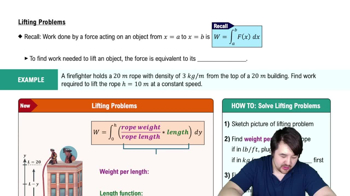
Lifting Problems
Work Done by a Variable Force
When force varies with position, work is calculated as the integral of the force over the displacement. For gravitational force that depends on distance, the work to move an object from one height to another is found by integrating the force function with respect to distance.
Recommended video:
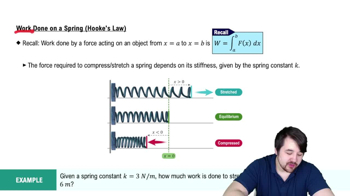
Work Done On A Spring (Hooke's Law)
Integration in Calculus
Integration is used to find the total accumulation of quantities, such as work done by a variable force. In this problem, integrating the gravitational force function from the initial to final position yields the total work required to move the rocket to the desired height.
Recommended video:
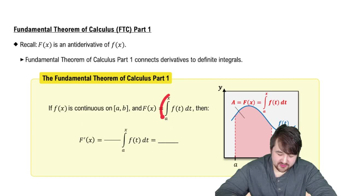
Fundamental Theorem of Calculus Part 1
Watch next
Master Introduction To Work with a bite sized video explanation from Patrick
Start learningRelated Videos
Related Practice
Textbook Question
5
views