2–74. Integration techniques Use the methods introduced in Sections 8.1 through 8.5 to evaluate the following integrals. 12. ∫ (8x + 5)/(2x² + 3x + 1) dx
Verified step by step guidance
1
Identify the integral to solve: \(\int \frac{8x + 5}{2x^{2} + 3x + 1} \, dx\).
Factor the denominator if possible. The quadratic \$2x^{2} + 3x + 1\( factors as \)(2x + 1)(x + 1)$.
Express the integrand as a sum of partial fractions: \(\frac{8x + 5}{(2x + 1)(x + 1)} = \frac{A}{2x + 1} + \frac{B}{x + 1}\), where \(A\) and \(B\) are constants to be determined.
Multiply both sides by the denominator \((2x + 1)(x + 1)\) to get: \$8x + 5 = A(x + 1) + B(2x + 1)\(. Then, expand and collect like terms to form an equation in \)x$.
Solve the system of equations for \(A\) and \(B\) by equating coefficients of \(x\) and the constant terms. Once \(A\) and \(B\) are found, rewrite the integral as the sum of two simpler integrals and integrate each using the natural logarithm rule: \(\int \frac{1}{ax + b} \, dx = \frac{1}{a} \ln|ax + b| + C\).
Verified video answer for a similar problem:
This video solution was recommended by our tutors as helpful for the problem above
Video duration:
4m
Play a video:
0 Comments
Key Concepts
Here are the essential concepts you must grasp in order to answer the question correctly.
Partial Fraction Decomposition
Partial fraction decomposition is a technique used to break down a rational function into simpler fractions that are easier to integrate. It is especially useful when the denominator can be factored into linear or quadratic terms. This method transforms the integral into a sum of simpler integrals.
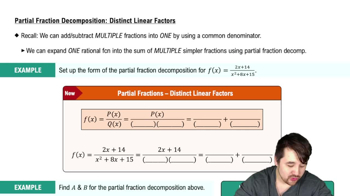
Partial Fraction Decomposition: Distinct Linear Factors
Integration of Rational Functions
Integrating rational functions involves expressing the integrand as a ratio of polynomials and applying algebraic techniques like substitution or partial fractions. Recognizing the form of the integrand helps determine the appropriate method to simplify and integrate the expression.
The substitution method simplifies integration by changing variables to transform the integral into a more manageable form. It is often used when the integrand contains a function and its derivative, allowing the integral to be rewritten in terms of a single variable.

 4:01 minutes
 Verified step by step guidance
 10:07
10:07