

Displacement from a table of velocities The velocities (in mi/hr) of an automobile moving along a straight highway over a two-hour period are given in the following table. (b) Find the midpoint Riemann sum approximation to the displacement on [0,2] with n = 2 and .n = 4 .
Verified step by step guidance
1
Understand that displacement over a time interval can be approximated by the integral of velocity over that interval. Here, we use the midpoint Riemann sum to approximate this integral.
For n = 2, divide the interval [0, 2] into 2 equal subintervals: [0, 1] and [1, 2]. The width of each subinterval is \( \Delta t = \frac{2 - 0}{2} = 1 \) hour.
Find the midpoints of each subinterval: for [0, 1], midpoint is 0.5; for [1, 2], midpoint is 1.5. Use the velocity values at these midpoints from the table: \( v(0.5) = 60 \) mi/hr and \( v(1.5) = 50 \) mi/hr.
Calculate the midpoint Riemann sum for n = 2 by multiplying each velocity at the midpoint by the subinterval width and summing: \( \text{Displacement} \approx \Delta t \times [v(0.5) + v(1.5)] \).
For n = 4, divide [0, 2] into 4 equal subintervals: [0, 0.5], [0.5, 1], [1, 1.5], and [1.5, 2]. The width of each subinterval is \( \Delta t = \frac{2 - 0}{4} = 0.5 \) hour. Find the midpoints: 0.25, 0.75, 1.25, and 1.75, and use the corresponding velocities from the table. Then calculate the sum \( \Delta t \times [v(0.25) + v(0.75) + v(1.25) + v(1.75)] \) to approximate the displacement.
Verified video answer for a similar problem:
This video solution was recommended by our tutors as helpful for the problem above
Video duration:
3m
Play a video:
Was this helpful?
Key Concepts
Here are the essential concepts you must grasp in order to answer the question correctly.
Displacement and Velocity Relationship
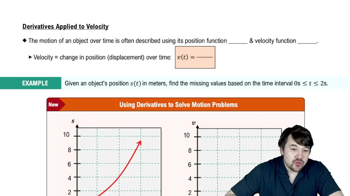
Displacement represents the change in position of an object and is found by integrating velocity over time. Since velocity is the rate of change of displacement, calculating displacement from velocity data involves summing or integrating velocity values over the given time interval.
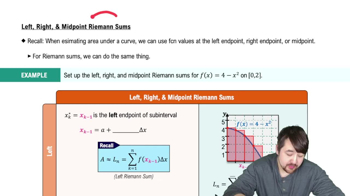
The midpoint Riemann sum approximates the integral of a function by using the function's value at the midpoint of each subinterval. This method often provides a better approximation than left or right sums, especially when the function is relatively smooth over the interval.
Dividing the interval [0,2] into n equal subintervals determines the width of each subinterval, Δt. For n=2 or n=4, the interval is split accordingly, and the midpoint of each subinterval is used to evaluate velocity for the Riemann sum approximation.