Ch. 3 - Derivatives
Briggs - Calculus: Early Transcendentals 3rd Edition
Briggs3rd EditionCalculus: Early TranscendentalsISBN: 9780136847243Not the one you use?Change textbook
Chapter 3, Problem 13

What is the derivative of y = e^kx?

Verified step by step guidance
1
Step 1: Identify the function y = e^{kx}, where k is a constant and x is the variable.
Step 2: Recall the derivative rule for exponential functions: if y = e^{u}, then \( \frac{dy}{dx} = e^{u} \cdot \frac{du}{dx} \).
Step 3: In this problem, u = kx. Therefore, we need to find \( \frac{du}{dx} \).
Step 4: Differentiate u = kx with respect to x. Since k is a constant, \( \frac{du}{dx} = k \).
Step 5: Apply the chain rule: \( \frac{dy}{dx} = e^{kx} \cdot k \). Thus, the derivative of y = e^{kx} is k \(\cdot\) e^{kx}.

Verified video answer for a similar problem:

This video solution was recommended by our tutors as helpful for the problem above.
Video duration:
2m
Was this helpful?

Key Concepts

Here are the essential concepts you must grasp in order to answer the question correctly.

Derivative

The derivative of a function measures how the function's output value changes as its input value changes. It represents the slope of the tangent line to the curve of the function at a given point. In calculus, the derivative is a fundamental concept used to analyze rates of change and is denoted as f'(x) or dy/dx.
Recommended video:
05:44
Derivatives

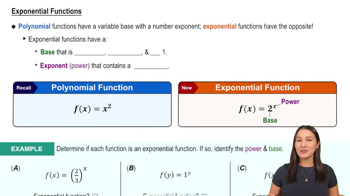
Exponential Functions

Exponential functions are mathematical functions of the form f(x) = a * e^(bx), where 'e' is Euler's number (approximately 2.71828), 'a' is a constant, and 'b' is a coefficient. These functions are characterized by their rapid growth or decay and are widely used in various fields, including finance, biology, and physics. The derivative of an exponential function has a unique property: it is proportional to the function itself.
Recommended video:
6:13
Exponential Functions

Constant Coefficient in Derivatives

When differentiating a function that includes a constant coefficient, such as 'k' in y = e^(kx), the derivative is affected by this coefficient. The rule states that the derivative of e^(kx) is k * e^(kx). This means that the rate of change of the function is scaled by the constant 'k', which influences how steeply the function increases or decreases.
Recommended video:
05:44
Derivatives