The accompanying figure shows the graph of a function f(x) with domain [0,2] and range [0,1]. Find the domains and ranges of the following functions, and sketch their graphs.
<IMAGE>
c. 2f(x)
Verified step by step guidance
1
Step 1: Understand the transformation applied to the function f(x). The function 2f(x) represents a vertical stretch of the original function f(x) by a factor of 2. This means that every y-value of f(x) is multiplied by 2.
Step 2: Determine the domain of the function 2f(x). Since the transformation is vertical, it does not affect the x-values. Therefore, the domain of 2f(x) remains the same as the domain of f(x), which is [0, 2].
Step 3: Determine the range of the function 2f(x). The range of f(x) is [0, 1]. By multiplying each y-value by 2, the new range becomes [0 * 2, 1 * 2], which is [0, 2].
Step 4: Sketch the graph of 2f(x). Start by sketching the graph of f(x) within its domain [0, 2] and range [0, 1]. Then, apply the vertical stretch by multiplying each y-coordinate by 2, resulting in a new range of [0, 2].
Step 5: Verify the transformation. Check that the graph of 2f(x) correctly reflects the vertical stretch by ensuring that all points on the graph of f(x) have their y-values doubled, and the domain remains unchanged.
Verified video answer for a similar problem:
This video solution was recommended by our tutors as helpful for the problem above
Video duration:
2m
Play a video:
Was this helpful?
Key Concepts
Here are the essential concepts you must grasp in order to answer the question correctly.
Function Transformation
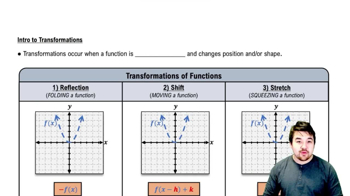
Function transformation refers to the process of altering a function's graph through operations such as scaling, translating, or reflecting. In the case of 2f(x), the function is vertically stretched by a factor of 2, which affects the range of the function while keeping the domain unchanged.
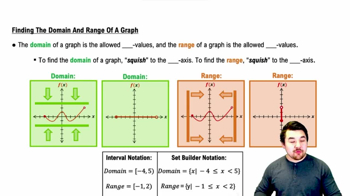
The domain of a function is the set of all possible input values (x-values) for which the function is defined, while the range is the set of all possible output values (y-values) that the function can produce. Understanding how transformations affect these sets is crucial for analyzing the new function derived from f(x).
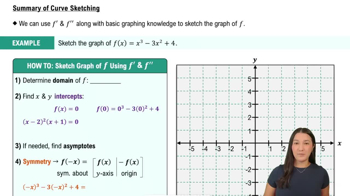
Graph sketching involves creating a visual representation of a function based on its characteristics, such as intercepts, asymptotes, and transformations. For the function 2f(x), one must consider how the vertical stretch modifies the original graph of f(x) to accurately depict the new function's behavior.