
In Exercises 69–76, graph each function not by plotting points, but by starting with the graph of one of the standard functions presented in Figures 1.14–1.17 and applying an appropriate transformation.
y = (−2x)²/³
Verified step by step guidance
1
Identify the base function: The given function is y = (−2x)²/³. The base function here is y = x²/³, which is a transformation of the cube root function y = x^(1/3).
Understand the transformation: The expression (−2x)²/³ involves two transformations: a horizontal scaling and a reflection. The factor of -2 inside the function indicates a reflection across the y-axis and a horizontal compression by a factor of 1/2.
Apply the reflection: Reflect the graph of y = x²/³ across the y-axis. This means that for every point (x, y) on the graph of y = x²/³, there will be a corresponding point (-x, y) on the graph of y = (−2x)²/³.
Apply the horizontal compression: After reflecting, compress the graph horizontally by a factor of 1/2. This means that each x-coordinate of the reflected graph is multiplied by 1/2, effectively making the graph narrower.
Sketch the transformed graph: Start with the graph of y = x²/³, apply the reflection and horizontal compression, and sketch the resulting graph. Ensure that the graph is symmetric with respect to the y-axis and note the changes in the shape due to the transformations.
Verified video answer for a similar problem:
This video solution was recommended by our tutors as helpful for the problem above
Video duration:
4m
Play a video:
Was this helpful?
Key Concepts
Here are the essential concepts you must grasp in order to answer the question correctly.
Standard Functions
Standard functions are basic functions that serve as building blocks for more complex functions. Examples include linear, quadratic, cubic, and absolute value functions. Understanding their shapes and properties is crucial for graphing transformations, as they provide a reference point for how transformations alter the graph.
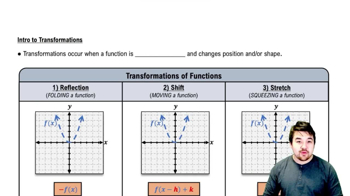
Function transformations involve shifting, stretching, compressing, or reflecting a graph. For example, multiplying a function by a negative value reflects it across the x-axis, while scaling factors can stretch or compress it. Recognizing these transformations helps in graphing complex functions by modifying the graph of a standard function.
Fractional exponents, such as ²/³, represent both roots and powers. The denominator indicates the root (cube root in this case), and the numerator indicates the power (squared here). Understanding how to manipulate and graph these expressions is essential for accurately representing functions with fractional exponents.